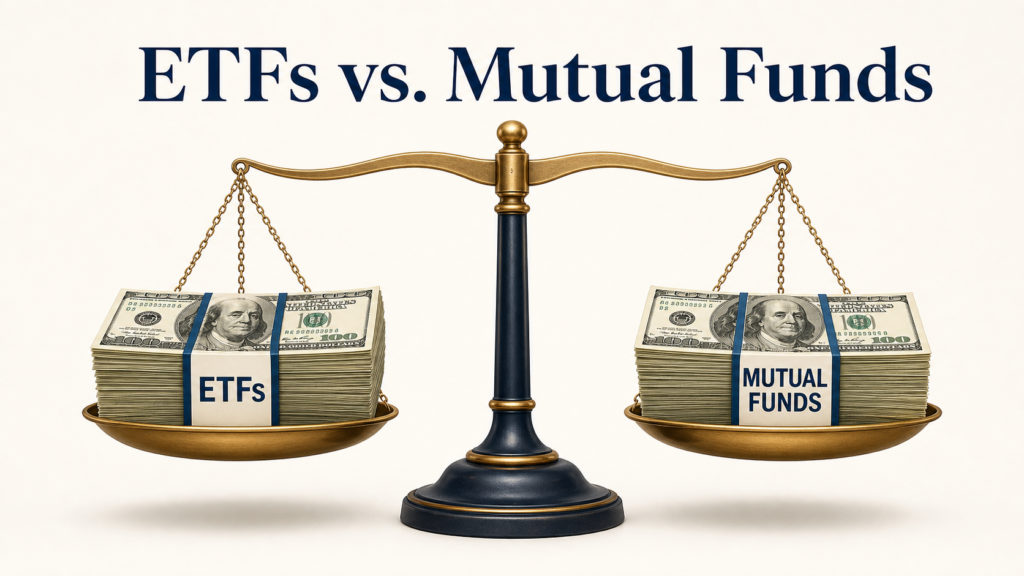
ETFs and mutual funds—including traditional open-end funds and lesser-known closed-end funds—can all provide diversification, but they operate in distinctly different ways. When comparing ETFs, open-end mutual funds, and closed-end funds, the most meaningful question is how each investment vehicle fits your goals, tax situation, risk tolerance, income needs, and desired level of portfolio oversight.
All three can provide diversification. They can hold stocks, bonds, or specialized market segments, and they may use passive or active management. The differences matter because they affect how you trade, what you pay, how distributions are funded, and how efficiently your investments may work in taxable accounts.
ETFs vs. Mutual Funds vs. Closed-End Funds: What Investors Should Know
There are two traditional fund structures investors should understand: open-end funds and closed-end funds.
The most common is the open-end mutual fund, which many people own through a 401(k) or other retirement plan. This type of fund continuously issues and redeems shares directly with investors. Transactions are completed at the fund’s end-of-day net asset value, or NAV.
The lesser-known structure is the closed-end fund, or CEF. A closed-end fund generally issues a fixed number of shares through an initial public offering. Afterward, those shares trade throughout the day on a stock exchange, much like individual stocks.
Because a CEF’s market price is determined by supply and demand, it can trade above or below the value of its underlying investments. When the market price is higher than NAV, the fund is trading at a premium. When it is lower, the fund is trading at a discount.
Buying a CEF at a discount may appear to mean you are purchasing a dollar’s worth of investments for less than a dollar. However, there is no guarantee that the discount will narrow. It could remain in place or grow wider, causing the market price to fall even when the value of the underlying portfolio remains relatively stable.
ETF vs. Closed-End Fund: Why Pricing Works Differently
Like a closed-end fund, an exchange-traded fund, or ETF, trades throughout the market day. Its price moves as buyers and sellers place orders. However, an ETF’s creation and redemption process generally helps keep its market price relatively close to its NAV. A closed-end fund does not have the same daily creation and redemption mechanism, so its discount or premium can be larger and may persist for years.
This distinction is important for investors who want more control over execution. With an ETF or publicly traded CEF, you can use limit orders to set the highest price you are willing to pay or the lowest price you are willing to accept. You can also sell during the day if market conditions change.
An open-end mutual fund order submitted during the day will typically receive that evening’s NAV, not the price in effect when you placed the order.
Neither structure is automatically superior. For a retirement account funded through regular automatic contributions, an open-end mutual fund can be simple and efficient. For an investor who values intraday flexibility, an ETF may be more practical. For an investor seeking regular income or access to specialized and less-liquid investments, a carefully selected CEF may be worth considering—provided the investor understands its additional risks.
How ETF and Closed-End Fund Leverage Affects Risk
One of the most important differences between most open-end mutual fund versus some CEFs and ETFs is the use of leverage. When those investments perform well and earn more than the cost of borrowing, leverage can increase the fund’s income and returns.
But leverage cuts both ways.
It can magnify losses, increase price volatility, and make the fund more vulnerable when interest rates rise or markets decline. A leveraged ETF or CEF may also be forced to reduce leverage at an unfavorable time to remain within required asset-coverage limits.
Before buying an ETF or CEF, investors should determine whether the fund uses leverage, how much it uses, what that leverage costs, and how it has affected performance during difficult markets.
Closed-End Funds Can Hold Less-Liquid Investments
Because a traditional closed-end fund is generally not required to redeem an investor’s shares on demand, its manager does not have to maintain the same amount of liquidity needed to meet daily shareholder redemptions.
This may give the manager greater flexibility to hold less-liquid investments, including certain municipal bonds, private companies, specialized debt instruments, or derivatives.
That flexibility can provide access to investments that may be difficult for an individual investor to purchase directly. It may also create additional risk. Less-liquid holdings can be harder to value and may be difficult to sell quickly without accepting a lower price.
Costs of ETFs, Mutual Funds, and Closed-End Funds
Expense ratios deserve attention, but they should not be the only cost consideration. Many broad-market ETFs and index mutual funds have relatively low internal expenses. Actively managed funds—whether they are ETFs, mutual funds, or CEFs—often cost more because they involve research, trading, and portfolio management.
Mutual funds may carry sales loads, redemption fees, or higher-cost share classes. In a traditional commission-based brokerage model, the financial professional may be paid when a client purchases a particular investment product. This compensation structure can create an incentive to recommend one fund or share class over another. By contrast, a fee-only fiduciary advisor is paid directly by clients and does not receive commissions from the investments recommended. This helps keep the focus on each investment’s costs, risks, and suitability for the client’s financial plan—not on how much the product pays the person selling it.
ETFs usually do not have sales loads, but they do have bid-ask spreads. This is the difference between the price a buyer is offering and the price a seller is asking. For large, widely traded ETFs, that spread can be narrow. For thinly traded or specialized ETFs, it can be more meaningful. Brokerage commissions, if any, and frequent trading can add costs as well.
Publicly traded CEFs also have bid-ask spreads and may involve brokerage commissions. In addition, their reported expense ratios may include the cost of leverage. That can make a leveraged CEF appear more expensive than an unleveraged fund, but the borrowing cost is still real and should not be ignored.
Investors should also be cautious when purchasing a newly issued CEF. Offering costs and sales compensation may be built into the initial price, and the shares may subsequently trade below their original offering price or NAV.
Which Fund Is More Tax-Efficient?
ETFs are often more tax-efficient than traditional mutual funds held in a taxable account. Their creation and redemption process can allow fund managers to manage capital-gains distributions more efficiently. As a result, an ETF investor may have greater control over when to realize a taxable gain by choosing when to sell shares.
Mutual fund shareholders can receive capital-gains distributions when the fund manager sells appreciated holdings, even if the shareholder did not sell any fund shares. That can create an unexpected tax bill in a strong market year.
Closed-end funds may also distribute dividends, interest income, and capital gains. Some CEF distributions may include return of capital, which means the fund is returning part of the investor’s original investment. Return of capital is not automatically good or bad, and its tax treatment can be complicated. However, investors should understand that a high distribution rate is not the same thing as a high investment return.
A managed distribution can provide regular cash flow, but the fund may pay more than its portfolio earns during a particular period. If the difference comes from a destructive return of capital, the payments can reduce the fund’s asset base and make future distributions harder to sustain.
This is not a blanket rule. Tax-managed mutual funds exist, and an ETF can still distribute income or generate taxable gains when you sell. Inside an IRA, 401(k), or other tax-deferred retirement account, the difference in annual tax efficiency is generally less important because taxes are not assessed on trades inside the account.
Active vs. Passive Fund Management
A common misconception is that ETFs are passive while mutual funds and CEFs are active. In reality, any of these vehicles may follow an index or use active management. The question is not simply whether a manager is involved. It is whether the investment approach is disciplined, transparent, and appropriate for your financial plan.
The closed-end structure may give an active manager additional flexibility because the manager generally does not have to sell holdings to meet daily shareholder redemption requests. That can be valuable when the strategy involves municipal bonds, specialized credit, or other investments that may not trade frequently.
However, active management does not eliminate risk. Investors must evaluate the manager’s record, the fund’s strategy, its use of leverage, its distribution history, and the relationship between its market price and NAV.
A passive index fund may make sense for investors seeking broad market exposure with low turnover. However, a portfolio designed only to buy and hold can leave investors exposed during prolonged bear markets. For retirees or those nearing retirement that plan on drawing income from investments, protecting capital during major declines may be as important as pursuing growth.
An actively managed approach can use fundamental research to identify companies with improving earnings and technical analysis to determine potentially favorable entry and exit points. It may also use defined risk-management disciplines, such as monitoring support levels, moving averages, and trailing stop-loss limits. These methods cannot eliminate market risk or guarantee a profit, but they can provide a more deliberate response than ignoring changing market conditions.
How to Choose the Right Investment Vehicle
Start with the account type and the job the investment needs to perform. For a taxable brokerage account, low-cost ETFs may offer attractive flexibility and tax efficiency. For a workplace retirement plan, open-end mutual funds may be the only practical options and can still be entirely suitable. For regular monthly investing, mutual funds can make automated contributions easy, although many brokerages now allow fractional ETF purchases as well.
A CEF may be considered when an investor wants regular distributions, access to specialized asset classes, or the opportunity to purchase a portfolio below its NAV. But investors should not select a CEF based solely on its distribution rate or discount.
Before buying one, ask:
- Is the fund trading at a premium or discount to NAV?
- How does the current valuation compare with its history?
- Does the fund use leverage, and what does that leverage cost?
- How much of the distribution comes from income, capital gains, or return of capital?
- Is the distribution reasonably supported by the portfolio?
- Does the fund hold investments that may be difficult to value or sell?
- What are the total operating and trading costs?
Then consider what you actually own. A fund’s label is less important than its holdings, concentration, fees, turnover, use of leverage, risk controls, and role in the broader portfolio. Owning several funds does not guarantee meaningful diversification if all of them are heavily concentrated in the same large technology stocks or market segment.
The right choice is often not strictly ETF or mutual fund—or even one fund structure. It may be a carefully selected combination of open-end funds, ETFs, and CEFs. It may also involve individual securities when that better supports an actively managed strategy.
What matters is that each holding has a purpose and is monitored in light of your retirement timeline, income needs, tax situation, and ability to tolerate losses.
A fee-only fiduciary financial planner should help you evaluate those trade-offs without steering you toward a product simply because it pays a commission. The best investment vehicle is the one that serves your plan, not the one with the most familiar name, the largest distribution, or the lowest headline expense ratio.
Byron Studdard is a CERTIFIED FINANCIAL PLANNER® professional and the founder of Studdard Financial, a fee-only fiduciary registered investment adviser serving clients from coast to coast from offices in Sarasota, FL and Memphis, TN. For more than thirty years, he has provided personalized investment advice, long-term wealth-building strategies, retirement planning guidance, and intergenerational wealth-transfer support to clients seeking disciplined, trustworthy financial oversight. His writing has been featured on the websites of ABC News, Good Morning America, and Yahoo. He can be reached at Byron@StuddardFinancial.com.
Investment Disclaimer
The information provided in this article is for educational and informational purposes only and should not be construed as financial, investment, tax, or legal advice. Nothing contained herein constitutes a recommendation, solicitation, or endorsement to buy, sell, or hold any security or investment. All investments involve risk, including the potential loss of principal. Past performance is not indicative of future results, and no investment strategy can guarantee profits or protect against losses in declining markets. The charts, technical analysis, support and resistance levels, moving averages, and other market observations presented are based on historical price data and are intended solely to illustrate technical analysis concepts. Market conditions can change rapidly, and technical indicators should not be relied upon as the sole basis for making investment decisions. Before making any investment decisions, you should conduct your own research, evaluate your financial situation and investment objectives, and consult with a qualified financial advisor or other licensed professional. You are solely responsible for your own investment decisions and the risks associated with them.
The author and publisher assume no liability for any losses or damages arising from the use of the information contained in this publication. You should carefully consider your risk tolerance, time horizon, and financial objectives before making investment decisions. By investing, you run the risk of losing money or losing buying power (where your money does not grow as fast as the cost of living). Investing involves risk and no investing strategy can prevent a loss or guarantee a gain, and our strategies are no different. Risk can be classified into many different categories, and by knowing those categories you can better manage expectations and avoid or reduce certain kinds of risk. This communication is meant to generally summarize the current outlook of the overall market and while it may make references to specific securities owned and/or trading strategies, theories, and philosophies, it is important to note that these are not used in every account or for every client. You should review your own account regularly to ensure it is being managed in the way you desire. Any performance data shown represents past performance, which is not a guarantee of future results. Investment returns and principal value will fluctuate so that investors’ shares, when sold, may be worth more or less than their original cost. Current performance may be lower or higher than the performance data cited. Artificial Intelligence (AI) is used occasionally to generate this content and the chart above was generated using AI and is of the Vanguard Total Stock Market ETF (ticker: VTI) which seeks to track the performance of the CRSP US Total Market Index including large-, mid-, and small-cap equity diversified across growth and value styles. The Center for Research in Security Prices (CRSP) is a vendor of historical time series data on securities. Academic, commercial, and government agencies use CRSP to access information such as price, dividends, and rates of returns on stocks. The FDIC does not insure money invested in stocks, bonds, mutual funds, or municipal securities.
Investment Advisory products/services are offered through Studdard Financial, LLC, a registered investment advisor. By industry regulation, we cannot accept time-sensitive information or orders to execute trades via e-mail, text, fax or voice mail. If you would like to execute a trade or if you have time-sensitive information, please call our office. If you receive any communication including but not limited to an email or text containing ACH or Wire withdrawal instructions, please call our office immediately. Do not click on any text or email link or contact anyone from any email unless we have discussed with you prior. Investing in stocks, bonds, exchange traded funds, mutual funds, and money market funds involve risk of loss. Loss of principal is possible. Some high-risk investments may use leverage, which will accentuate gains & losses. Foreign investing involves special risks, including greater volatility and political, economic and currency risks and differences in accounting methods. A securities or a firm’s past investment performance is not a guarantee or predictor of future investment performance. This electronic message transmission contains information that may be confidential or privileged. If you desire to a copy of our Form ADV, Part 2A brochure or a copy of our privacy policy, please contact us at (901)355-4713 or via email at byron@studdardfinancial.com. The information transmitted by this email is intended only for the person or entity to which it is addressed. This email may contain proprietary, confidential and/or privileged material. If you are not the intended recipient of this message, be aware that any use, review, retransmission, distribution, reproduction or any action taken in reliance upon this message is strictly prohibited. If you received this in error, please contact the sender and delete the material from all computers.
Copyright © 2026 Studdard Financial, LLC, All rights reserved.