
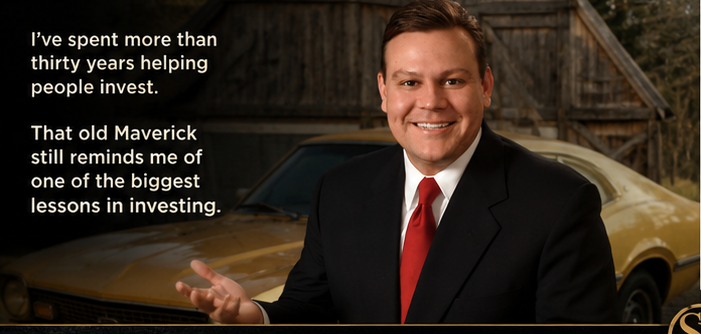
The day I turned sixteen was one of the happiest days of my life.
I'd saved about $2,000 for my first car.
Like most teenage boys, I wanted a classic Mustang—preferably a 1965 or 1967 model. The problem was simple. If I spent all my money buying one, I'd have nothing left to restore it.
My father wasn't much of a car enthusiast, but he mentioned that a coworker we affectionately called "Big Jim" had an old Mustang for sale that had been sitting in the parking lot of his apartment complex for years and didn't run.
My heart raced with excitement.
When we arrived, I quickly discovered it wasn't a Mustang at all.
It was a 1973 Ford Maverick.
Big Jim had been given a company car, so the Maverick had been sitting outside for years. It was covered in dirt, tree sap, and bird droppings and the vinyl roof was peeling so bad that you could see rusted metal under it. The tires were flat, it wouldn't start, and it looked like it belonged in a junkyard.
It was perfect. Well, it was perfect for my budget.
I bought it for $150.
Big Jim let us work on it right there in the apartment parking lot until we finally got it running.
Over the next couple of weeks, my father patiently taught me things every young man should know—how to change the oil, replace spark plugs, install a new battery, and flush the radiator. The Maverick still had plenty of problems. The gas gauge had a mind of its own, there were no seat belts, no air conditioning, and the brakes were living on borrowed time.
But little by little, the old Ford began coming back to life.
Once it was running and wearing a new set of tires, it was finally time for the Maverick to leave the apartment complex it had called home for years. I imagine the neighbors were thrilled to see that old eyesore disappear.
Our first stop wasn't home.
It was the self-service car wash -I couldn't wait to make it shine.
As I blasted years of dirt and grime off the car with the pressure washer, something unexpected happened.
The old vinyl roof began peeling off in strips and raining down on top of me.
My dad burst out laughing.
I didn't find it nearly as funny.
Then he handed me a few more quarters and said, "You were going to take it off anyway."
My mother wasn't nearly as amused. She took one look at my half-naked Maverick and insisted I park it behind the house where the neighbors wouldn't have to look at it.
The next day we sanded and primed the roof. I drove it that way for several months until I had saved enough money to take it to Uncle Kenneth for the bodywork and paint. In the meantime, I spent hours with rubbing compound bringing the faded yellow paint back to life. It wasn't perfect, but every afternoon it looked a little better than it had the day before.
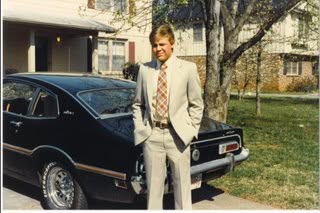

The real test, though, wasn't getting it fixed up.
It was whether it would survive taking a girl out on a date.
By then I was flipping burgers at Burger King while waiting for a position to open at Walmart. During my first week, I got the phone number of a girl who worked there.
Getting her to go out with me, however, proved much more difficult.
So, I kept asking other girls out and finally managed to convince one to go to dinner and a movie with me on Saturday night.
She only had one request. "Let's not eat at Burger King."
She knew I had been trying to impress the girl who worked there. There went my budget—and my hopes of making my Burger King crush jealous.
Fortunately, she wasn't asking for white-tablecloth dining—just someplace a little nicer than where I worked… and preferably somewhere the other girl wouldn't see us.
I was so excited about having my first real date in my own car that I spent the entire afternoon getting the Maverick ready. I rubbed out the paint until my fingers blistered, polished my chrome wheels until you could see your reflection in them, and vacuumed every inch of the interior.
My old Maverick wasn't fast. It wasn't pretty. But to me, it was perfect.
There was just one problem.
The gas gauge couldn't be trusted.
I had learned to fill the tank every 200 to 250 miles just to be safe. On this particular Saturday, however, I was thinking a lot more about my date than my fuel level.
You can probably guess what happened.
Sure enough, the Maverick sputtered to a stop.
Ironically, we ran out of gas on the parkway directly in front of the Burger King where both I—and the girl I had really wanted to date—worked.
As the cars behind us started blowing their horns, my date calmly slid behind the steering wheel while I climbed out and started pushing.
She was a much better sport than I deserved.
There was only one problem – I weighed about 160 pounds soaking wet and it weighed considerably more.
As I pushed my car toward the Burger King parking lot that Saturday night, I was fortunate to have mostly level ground, but the entrance had a slight incline. About halfway up, my momentum disappeared. The Maverick stopped.
Then it started rolling backward. Toward me.
I remember thinking, This is just great. I finally convinced someone to go out with me and I'm going to die in the Burger King parking lot. I could see the headlines, "Idiot kid run over by his own car."
Thankfully, some of my friends inside the restaurant saw what was happening and came running out to help push us the rest of the way.
My date never complained—even after she had to sit inside Burger King while a coworker drove me home to borrow my mother's car. The Maverick ended up spending the night in the Burger King parking lot.
She laughed through the entire ordeal. It was probably more excitement than she had signed up for. It was our last date.
Honestly, I can't say I blame her.
Apparently, running out of gas isn't considered an attractive quality, because it too me even longer to convince the Burger King girl to go on a date and even then, she offered to drive.
Looking back, that old Maverick taught me one of the earliest lessons of value investing.
Like many great investments, its value wasn't in how impressive it looked.
It was in how faithfully it served its purpose.
Over the next year, I poured nearly every dollar I earned into that car.
With my Uncle Kenneth's help, I painted it, reupholstered the interior and upgraded parts. I never fixed the gas gage, but made sure to keep it full – especially on date nights.
Little by little, that old Maverick became something I was genuinely proud to drive.
But it never became a Mustang.
That turned out to be the most valuable lesson of all.
While I was investing my time and money into the Maverick, the Mustangs I'd originally wanted continued appreciating in value.
The market simply valued them differently. My Maverick looked far better than the day I bought it. It drove better.
It was certainly worth more than the $150 I'd paid.
But no matter how much work I put into it…
It would never command the value of a comparable Mustang.
Years later, I realized investing works much the same way. Some businesses are temporarily overlooked. They're fundamentally strong companies trading below their true value because the market has become overly pessimistic.
Those can become tremendous investments. Other businesses are simply mediocre companies selling at low prices. They may improve. They may even become good companies.
But they'll never become exceptional businesses. That's one of the greatest challenges in value investing. Determining whether something is undervalued…or merely inexpensive.
What Value Investing Actually Means
Value Investing is the practice of estimating a company’s economic worth and comparing that estimate with its current market price. A stock may deserve consideration when its price is meaningfully below the value supported by the company’s earnings, financial condition, competitive position, and future prospects.
This is different from buying a stock merely because it has declined. A falling price is not proof of a bargain. Sometimes it reflects temporary fear or an overreaction to disappointing news. Other times, it reflects a business with shrinking earnings, too much debt, deteriorating demand, or a competitive problem that will not resolve easily.
A value investor asks a more useful question: Is the market underestimating this company’s ability to produce cash and grow earnings over time?
Business Quality Comes Before a Low Price
A low valuation can be attractive, but quality matters. Investors should examine whether a company has durable earnings, manageable debt, capable leadership, a defensible market position, and a realistic path to continued growth.
Fundamental analysis helps answer those questions. Earnings trends, revenue growth, profit margins, free cash flow, debt levels, and return on invested capital can show whether a business is strengthening or weakening. No single ratio provides the complete answer. A low price-to-earnings ratio, for example, may signal an overlooked opportunity, but it can also indicate that investors expect earnings to decline.
The strongest opportunities often involve companies with improving fundamentals that have not yet received full recognition from the broader market. That requires patience, research, and a willingness to avoid popular narratives when the facts do not support them.
Price Discipline Still Matters
Even a strong business can be a poor investment if purchased at an unreasonable price. When investors pay too much for future growth, even good earnings reports may fail to produce satisfactory returns.
That is why valuation should be considered alongside quality. A thoughtful process may compare the current price with earnings potential, historical valuation ranges, industry conditions, and reasonable expectations for growth. The objective is not to identify a perfectly precise intrinsic value. No one can do that with certainty. The objective is to make a sound, evidence-based judgment with a margin for error.
A margin of safety means buying with enough room between estimated value and market price to help protect against mistakes in analysis, unexpected economic pressure, or a slower-than-expected recovery. It is a discipline, not a guarantee.
Why Active Risk Management Can Complement Value Investing
Traditional value investing is often associated with buying and holding through every market cycle. Long-term ownership can be appropriate in some circumstances, but passive holding also has a serious limitation: markets can experience sharp declines that take years to recover.
For investors who want a more active approach, fundamental research can identify what may be worth owning while technical analysis can help guide when to buy, reduce, or sell. Support and resistance levels, moving averages, volume, and chart patterns do not predict the future. They can, however, provide useful evidence about market behavior and changing momentum.
At Studdard Financial, this combined approach is designed to avoid treating a portfolio as a collection of funds set on autopilot. Fundamental analysis helps evaluate companies and sectors, while technical chart analysis helps determine entry and exit points. Trailing stop-loss limits may also be used in an effort to protect gains and limit losses when market conditions deteriorate.
There are trade-offs. A stop-loss order can be triggered by a short-term decline and a stock can rebound afterward. In a fast-moving market, the sale price may be lower than the selected stop price. Active management can also create taxable transactions in non-retirement accounts. These realities should be weighed against the potential benefit of responding when a position no longer behaves as expected.
Value Investing Should Serve Your Financial Plan
A sound investment decision must fit more than a stock screen. Your retirement timetable, income needs, tax situation, liquidity reserves, risk tolerance, and estate-planning goals all matter. A pre-retiree drawing on a portfolio soon has different concerns than a mid-career professional with decades before retirement.
For families building wealth, preparing for retirement, or protecting assets already accumulated, the goal is not simply to buy stocks that appear inexpensive. It is to understand what you own, why you own it, and what evidence would tell you the investment case has changed.
That is also why fiduciary advice matters. Under the fiduciary standard applicable to registered investment advisors, recommendations should be made in the client’s best interest, with transparent compensation and clear attention to the client’s circumstances. Investment decisions should support a financial plan, not become a substitute for one.
Great value investors don't buy stocks simply because they're cheap.
They buy businesses whose intrinsic value is significantly greater than the price the market is currently willing to pay.
There's a big difference.
Because sometimes you're buying the next Mustang…
And sometimes…
You're just buying a nicer Maverick – but I wouldn’t trade it for the world.
Byron Studdard is a CERTIFIED FINANCIAL PLANNER® professional and the founder of Studdard Financial, a fee-only fiduciary registered investment adviser serving clients from coast to coast from offices in Sarasota, FL and Memphis, TN. For more than thirty years, he has provided personalized investment advice, long-term wealth-building strategies, retirement planning guidance, and intergenerational wealth-transfer support to clients seeking disciplined, trustworthy financial oversight. His writing has been featured on the websites of ABC News, Good Morning America, and Yahoo. He can be reached at Byron@StuddardFinancial.com.
Related service: Learn how Studdard Financial approaches Investment Management, or schedule a consultation with Byron Studdard, CFP®.