
Most people wait too long to get serious about retirement, then panic when the numbers don’t add up. If you’re searching for financial advice for retirement planning that actually holds up once the paychecks stop, you’re already ahead of the crowd who just hope Social Security and a 401(k) will cover it.
Here’s the direct answer: solid retirement planning for individuals comes down to a handful of decisions, made early and revisited often, about savings rate, investment mix, tax exposure, and how you’ll turn assets into reliable income. There’s no secret formula, just disciplined choices applied consistently over decades.
This article breaks down nine practical tips covering everything from income planning for retirement to tax-efficient withdrawals and estate considerations. I’ve worked with clients at every stage of this process for over thirty years as a CFP® professional, and these are the strategies that consistently separate a comfortable retirement from a stressful one. Whether you’re a decade out or already retired, you’ll find something here worth adjusting in your own plan.
1. Work with a fee-only fiduciary financial advisor
The single biggest decision in retirement planning for individuals happens before you ever pick an investment: choosing who gives you advice and how they get paid. A commission-based broker can legally recommend a product that pays them more, even if a cheaper one suits you better. A fee-only fiduciary, by contrast, is paid directly by you and is legally bound to put your interests first, full stop.
Why it matters
Conflicts of interest are quiet and expensive. Studies from the Department of Labor have estimated that conflicted advice costs retirement savers billions annually in excess fees and underperformance. Working with someone whose only incentive is your success, rather than a sales quota, removes that drag entirely.
A fiduciary gets paid to grow your money, not to sell you a product.
How to put it into practice
Before hiring anyone, ask directly how they’re compensated and get it in writing, and know what to ask before hiring a retirement planner. Here’s what to check:
- Fee structure: Look for “fee-only,” not “fee-based,” which can still include commissions.
- Credentials: A CFP® designation requires rigorous exams, continuing education, and an ethics requirement.
- Fiduciary oath: Ask if they’ll sign a written fiduciary pledge for every recommendation, not just some accounts.
- Track record: How long have they practiced, and do they specialize in retirement income planning specifically?
At Studdard Financial, Byron Studdard has been a CFP® professional since 1997 and operates strictly as a fee-only fiduciary, compensated directly by clients rather than through commissions on the products he recommends. That structure exists precisely so recommendations reflect what’s best for your situation.
Common pitfalls to avoid
Too often, people assume anyone with the title “financial advisor” owes them a fiduciary duty. That’s false. Many advisors only meet a lower “suitability” standard, which just means a product has to be reasonable, not optimal. Watch for vague answers when you ask about compensation, that hesitation usually signals commissions are involved somewhere.
Never sign paperwork without understanding every fee layer, including fund expense ratios stacked on top of advisory fees. Some investors also make the mistake of switching advisors too often, chasing performance instead of process. A good fiduciary relationship should last years, not months, because retirement planning is a long game that rewards consistency over chasing whoever had the best quarter.
2. Start saving early and automate your contributions
Compound growth rewards time more than it rewards timing. Any piece of financial advice for retirement planning worth following starts here: the money you save at 25 grows for 40 years, while money saved at 45 only gets 20, which is why saving priorities look different in each decade. That gap is the difference between a comfortable retirement and one where you’re stretching every dollar.
Why it matters
Delaying by even ten years can cut your final balance in half, even if you eventually save more per month to compensate. A 25-year-old saving $300 monthly at 7% growth ends up with roughly $720,000 by 65. Wait until 35 to start, and that same monthly amount only reaches about $340,000. Automated contributions remove the willpower problem entirely, since money moving before you see it never gets spent on something else.
The best time to start saving was your first paycheck. The second best time is your next one.
How to put it into practice
Set up automatic transfers the same day your paycheck lands, ideally into a 401(k) or IRA before you can touch it. Increase your contribution rate by 1% every year, tied to raises so you never notice the difference in take-home pay. Retirement planning for individuals works best when saving becomes as automatic as paying rent, not a decision you revisit monthly.
Common pitfalls to avoid
Skipping months during tight budget stretches feels harmless but breaks the compounding chain that makes early saving powerful in the first place. Treating raises as spending money instead of savings opportunities keeps your savings rate flat for decades. Underestimating how much a delayed start costs is the biggest mistake, people assume they’ll “catch up later” without running the actual math on what that catch-up requires.
3. Calculate exactly how much you need to retire
Guessing at a retirement number is how people end up either overworking into their seventies or running out of money at eighty. Solid financial planning for retirement starts with a real number, calculated from your actual expenses, not a rule of thumb pulled from a magazine article. That number tells you exactly how much to save, invest, and adjust before you ever hand in a resignation letter.
Why it matters
Without a target, you can’t measure progress or know when you’re actually ready. A common shortcut, the 4% withdrawal rule, suggests you need roughly 25 times your annual expenses saved. Someone spending $70,000 a year would need approximately $1.75 million. But that rule assumes a 30-year retirement and a specific investment mix, so it’s a starting point, not gospel.
You can’t hit a target you’ve never actually set.
How to put it into practice
Start with your real spending, not a guess:
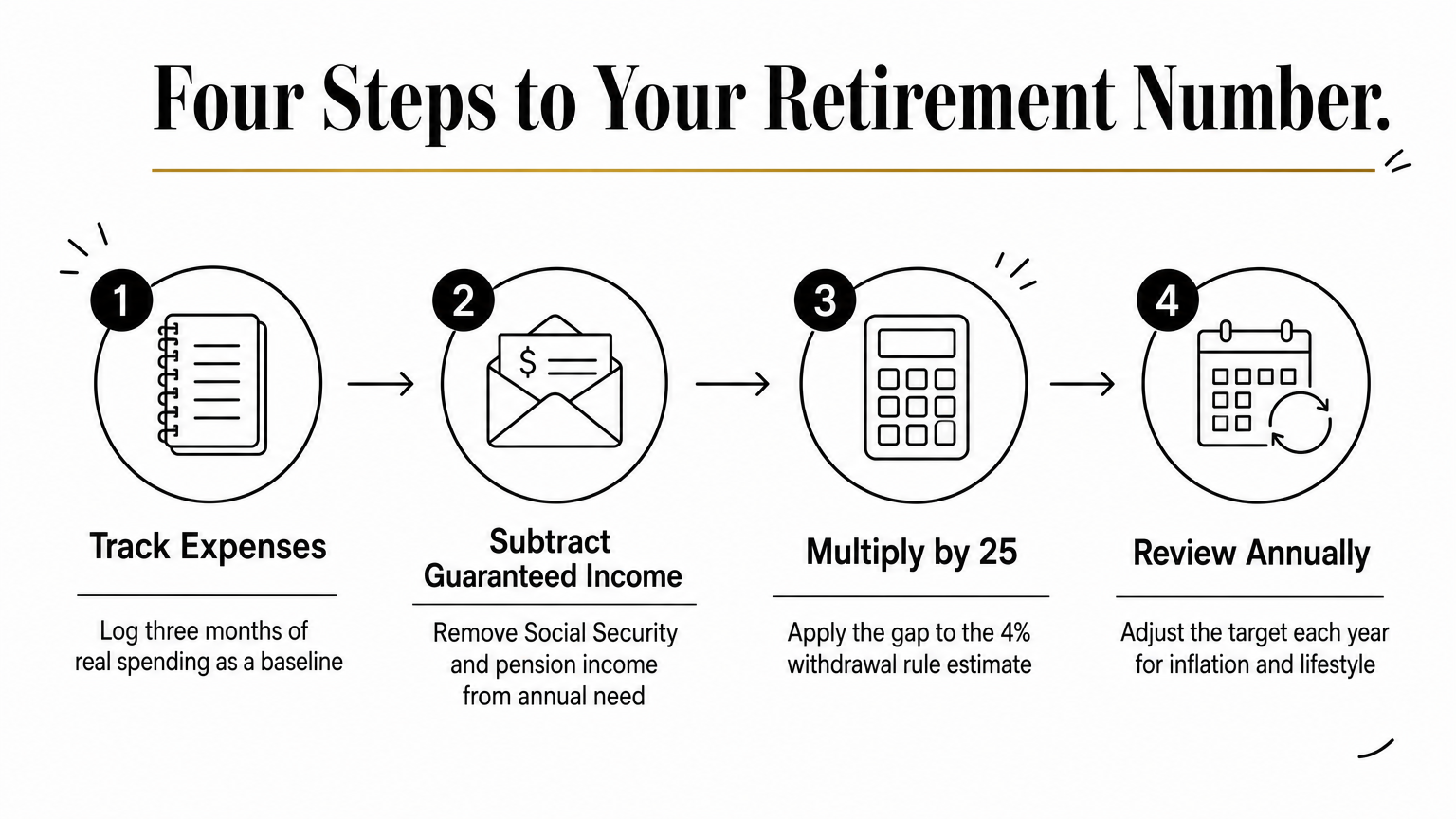
- Track current expenses for three months to get an honest baseline, then adjust for costs that disappear (commuting) or grow (travel, healthcare) in retirement.
- Subtract guaranteed income like Social Security and pensions from your annual need.
- Multiply the remaining gap by 25 to estimate your required nest egg.
- Run the numbers annually in a yearly review of your retirement plan, since inflation and lifestyle changes shift the target every year.
Retirement calculators help, but a customized projection built around your actual accounts and timeline, the kind we build for clients when measuring true retirement readiness, catches details a generic tool misses.
Common pitfalls to avoid
Underestimating healthcare costs is the most expensive mistake in this exercise, since medical spending tends to rise faster than general inflation. Ignoring inflation entirely on a 20 or 30-year horizon quietly erodes purchasing power that a static number never accounts for. People also anchor on outdated targets, like “$1 million is enough,” without recalculating for their specific spending and life expectancy.
4. Maximize employer retirement plans and matching funds
An employer match is the closest thing to free money you’ll find in personal finance, yet plenty of workers leave it on the table every year. If your company offers a 401(k) match and you’re not contributing enough to capture the full amount, you’re walking past guaranteed returns no market investment can promise. This is one of the simplest pieces of financial advice for retirement planning to act on, because the decision requires no market timing, no forecasting, just a form.
Why it matters
A typical match of 50 cents on the dollar up to 6% of pay is an instant 50% return before your money even touches the market. Skip that, and you’ve effectively taken a pay cut nobody forced on you. Beyond the match, employer plans offer payroll deduction discipline and often lower institutional fund costs than you’d find opening an account on your own.
Skipping the match isn’t saving, it’s declining part of your paycheck.
How to put it into practice
Check your plan document or HR portal for the exact match formula, since “3% match” and “50% up to 6%” produce very different numbers. Contribute at least enough to capture the full match immediately if cash flow allows. Review your plan’s investment lineup once a year, since default target-date funds aren’t always the cheapest or best-fit option available inside the plan.
Common pitfalls to avoid
Contributing just below the match threshold, say 4% when the plan matches up to 6%, quietly forfeits money every single pay period. New employees sometimes wait out a vesting period misunderstanding, delaying enrollment when they should start immediately even if matched funds vest later. Job changers also forget to roll over old 401(k)s, leaving accounts scattered across former employers where nobody is actively managing the allocation.
5. Diversify your investments to match your risk tolerance
A portfolio that’s all stocks feels great in a bull market and terrifying in a downturn, right when you can least afford to sell. Real financial planning for retirement means building an allocation that matches your actual timeline and stomach for volatility, not the market’s mood or last year’s returns. Diversification isn’t about chasing the hottest sector, it’s about owning enough different assets that no single bad year wrecks your plan.
Why it matters
Sequence of returns risk, the danger of a market crash hitting right as you start withdrawals, can permanently damage a retirement portfolio even if long-term average returns look fine on paper. A retiree who loses 30% in year one and then withdraws income on top of that loss may never fully recover, even in a market that eventually rebounds. Spreading money across stocks, bonds, and cash reserves cushions those early years when your portfolio is most vulnerable, and there are other ways retirees blunt this risk as well.
Diversification is the only strategy that protects you when you don’t know which asset will underperform next.
How to put it into practice
Match your stock-to-bond mix to your time horizon and withdrawal needs, not just your age. Some practical starting points:
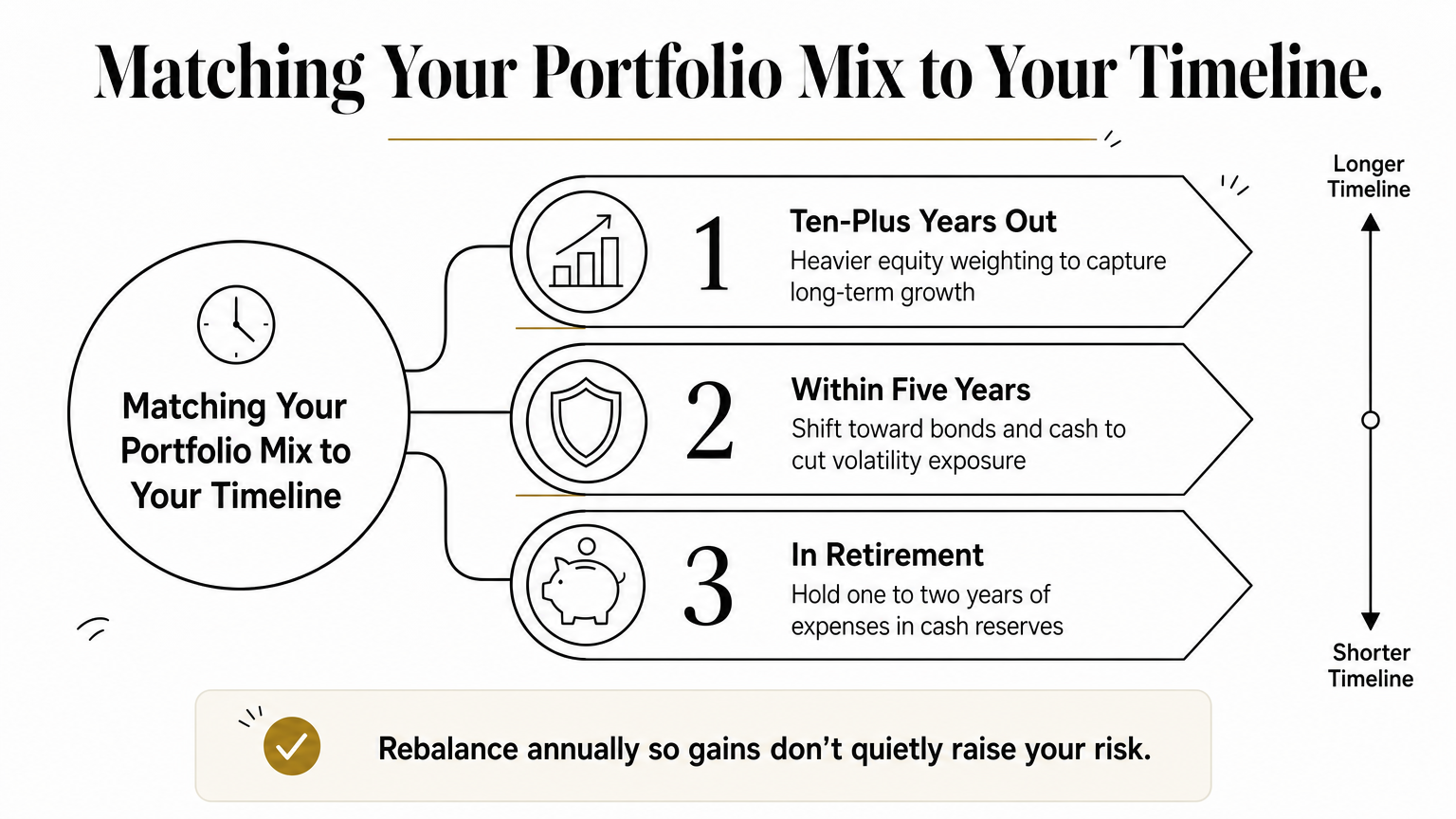
- Ten-plus years to retirement: heavier equity weighting to capture growth.
- Within five years of retirement: shift toward a lower risk allocation to reduce volatility exposure.
- In retirement: keep one to two years of expenses in cash or short-term bonds so you’re never forced to sell stocks during a downturn.
Rebalance annually to keep your target allocation intact, since a strong stock market year can quietly push your portfolio riskier than intended.
Common pitfalls to avoid
Holding too much employer stock concentrates risk in the same company that pays your salary, a double exposure that hurts twice if that company struggles. Chasing last year’s top-performing fund instead of sticking to a written allocation plan leads to buying high and selling low. Ignoring risk tolerance entirely, whether too conservative in your thirties or too aggressive at sixty-five, both quietly sabotage the retirement income this money is supposed to fund.
6. Time your Social Security claim strategically
Social Security feels simple until you realize the claiming age you pick locks in a payment amount for the rest of your life. Delaying from age 62 to 70 boosts your monthly benefit by roughly 8% per year past full retirement age, a guaranteed increase no market investment matches without risk – but you have to live long enough to break-even, so it pays to weigh the real tradeoffs of collecting at 62. Good income planning for retirement treats this decision as a strategic choice tied to health, other assets, and marital status, not a default you make the day you stop working.
Why it matters
Claiming at 62 instead of 70 can mean a benefit that’s 76% smaller for the rest of your life, according to the Social Security Administration. For married couples, the higher earner’s claiming age also determines the survivor benefit the remaining spouse receives, so an early claim by the primary earner can permanently shrink a widow’s or widower’s income decades later.
The age you claim Social Security is a permanent decision disguised as a simple form.
How to put it into practice
Before filing, weigh these factors together rather than in isolation:
- Health and family longevity: Shorter life expectancy may favor claiming earlier; longer family history favors delaying.
- Spousal coordination: Have the higher earner delay when possible to maximize the survivor benefit, one of several ways couples can align their retirement goals.
- Other income sources: Use savings or part-time work to bridge income if delaying past 62 makes sense financially.
- Break-even analysis: Run the math on total lifetime benefits under different claiming ages given your specific numbers.
A written income planning for retirement strategy should model these scenarios years before you actually file, not the month you decide to retire.
Common pitfalls to avoid
Filing immediately at 62 out of habit, without running the numbers, is the most common and costly mistake retirees make. Couples often decide independently instead of coordinating claims, missing survivor benefit optimization entirely. People also forget that working while claiming early can temporarily reduce benefits through the earnings test, a detail that catches many by surprise their first year.
7. Plan ahead for healthcare and long-term care costs
Medical expenses catch more retirees off guard than almost any other line item, mostly because Medicare doesn’t cover nearly as much as people assume. Solid financial planning for retirees has to account for premiums, deductibles, dental, vision, and the very real chance of needing extended long-term care. Skip this step, and even a well-funded portfolio can get drained fast by a single health event.

Why it matters
Fidelity estimates a 65-year-old couple retiring today will spend roughly $330,000 on healthcare throughout retirement, and that figure excludes long-term care entirely. Medicare covers hospital stays and doctor visits reasonably well, but it doesn’t pay for extended nursing home care or most in-home assistance. According to Medicare.gov, a private room in a nursing facility can run well over $100,000 a year, a cost that can wipe out savings meant to last decades in just a few years.
Healthcare isn’t a line item you budget for once, it’s a cost that grows faster than everything else in your plan.
How to put it into practice
Build healthcare into your retirement number, not as an afterthought but as a dedicated bucket:
- Budget for Medicare premiums, supplements, and out-of-pocket costs separately from general living expenses.
- Price long-term care insurance in your late 50s or early 60s, when premiums are still affordable and health qualifies you.
- Consider a Health Savings Account while working, since HSA funds grow tax-free and cover medical costs tax-free in retirement too.
- Discuss care preferences with family now, since decisions made in a crisis rarely align with what you’d have chosen calmly.
Common pitfalls to avoid
Assuming Medicare covers everything is the single costliest misconception in retirement planning. Waiting too long to shop for long-term care insurance often means facing denial or premiums that make coverage impractical. Families also avoid the long-term care conversation entirely, then scramble to make decisions under pressure that a calm, funded plan could have handled years in advance.
8. Build a tax-efficient retirement income strategy
How you withdraw money matters almost as much as how much you saved, because the goal is turning a portfolio into income that lasts. Two retirees with identical million-dollar portfolios can end up with very different after-tax incomes depending on which accounts they tap first. Smart income planning for retirement treats your 401(k), Roth IRA, and taxable brokerage account as three different tax buckets, each pulled from strategically rather than randomly, which is the heart of a withdrawal order built to last.
Why it matters
Every dollar you pull from a traditional 401(k) or IRA counts as ordinary income, potentially pushing you into a higher bracket or triggering higher Medicare premiums through IRMAA surcharges. Roth withdrawals, by contrast, come out completely tax-free, giving you a lever to control your taxable income year by year. Get the sequencing wrong and you could pay thousands more in taxes over a 25-year retirement than someone with the identical portfolio who withdrew strategically.
The order you withdraw from matters as much as the amount you withdraw.
How to put it into practice
A basic withdrawal sequence usually starts with taxable accounts, then tax-deferred, then Roth last, but your specific bracket situation can change that order:
- Fill low tax brackets deliberately in early retirement years before Social Security and Required Minimum Distributions begin.
- Consider Roth conversions during lower-income years, paying tax now at a known rate instead of an unknown future rate, one of several ways to cut your lifetime tax bill in retirement.
- Coordinate withdrawals with Medicare IRMAA thresholds, since crossing certain income levels triggers permanently higher premiums for that year.
- Track RMD start ages carefully, since missing a required distribution carries steep IRS penalties.
Common pitfalls to avoid
Withdrawing evenly across all accounts without regard to tax bracket wastes an opportunity to control your taxable income deliberately. Ignoring Roth conversion windows in the years between retirement and RMDs leaves free tax-bracket space unused forever. Many retirees also forget that large one-time withdrawals, like paying for a new roof from a traditional IRA, can spike a single year’s tax bill and Medicare premiums far more than spreading that withdrawal across two years would.
9. Keep your estate plan and legacy documents current
Most people write a will once, file it away, and never look at it again, even after a divorce, a new grandchild, or a decade of asset growth. Thorough financial planning for retirees has to include estate documents that actually reflect your current life, not the one you had when you signed them. An outdated plan can undo decades of careful saving in a single probate court delay.
Why it matters
Beneficiary designations on retirement accounts and life insurance override whatever your will says, so an ex-spouse or a deceased parent listed years ago can still legally inherit funds meant for someone else. Powers of attorney and healthcare directives also expire in practical terms when the people named have passed away or become unreachable, leaving your family without legal authority during a medical crisis. Estate planning protects the people you love from confusion and conflict at the worst possible moment, and building the plan tax-efficiently for your family keeps more of what you leave behind intact.
An outdated beneficiary form can undo thirty years of careful planning in one signature.
How to put it into practice
Review these documents every three years or after any major life event:
- Will and trust documents: Confirm they still match your wishes and current asset picture.
- Beneficiary designations: Check every retirement account, annuity, and life insurance policy directly with the custodian.
- Power of attorney and healthcare directive: Name current, willing, and capable people.
- Digital assets and account access: Leave clear instructions so family isn’t locked out of accounts they need to manage.
Our estate planning support folds these reviews into your broader retirement plan so nothing gets overlooked between annual check-ins.
Common pitfalls to avoid
Assuming a will alone controls everything ignores how beneficiary forms actually work. Families also avoid these conversations out of discomfort, then leave heirs guessing during grief. Naming only one power of attorney with no backup leaves you exposed if that person becomes unavailable when you need them most.
Turning this advice into your retirement plan
Nine tips, one common thread: financial advice for retirement planning only works when someone actually applies it, consistently, over years rather than months. You don’t need to tackle all nine at once. Pick the one you’ve neglected most, whether that’s calculating your real number or dusting off an estate plan from a decade ago, and fix that first.
Going it alone means juggling tax rules, market shifts, and Social Security timing without a second set of eyes checking your math. A personalized retirement strategy built around your actual accounts, goals, and timeline catches gaps that generic advice never will. Byron Studdard has spent over thirty years helping individuals and families turn scattered accounts into coordinated plans that hold up in retirement.
If you’re ready to move from reading about retirement planning to actually building yours, see how our retirement planning services work and schedule a consultation with Studdard Financial.
About Byron L. Studdard, CFP®
Byron L. Studdard is a CERTIFIED FINANCIAL PLANNER® professional and the founder of Studdard Financial – a fee-only fiduciary registered investment adviser serving clients from coast to coast from offices in Sarasota, FL and Germantown (Memphis), TN. For more than thirty years, he has provided personalized investment advice, retirement planning guidance, social security maximization strategies, and intergenerational wealth-transfer support to clients seeking disciplined, trustworthy financial oversight. His writing has been featured on the websites of ABC News, Good Morning America, and Yahoo. He can be reached at Byron@StuddardFinancial.com.
Important Disclosures:
All information provided is for educational purposes only and does not constitute investment, legal or tax advice; an offer to buy or sell any security or insurance product; or an endorsement of any third party or such third party’s views. The information contained herein has been obtained from sources we believe to be reliable but is not guaranteed to be accurate or complete. Studdard Financial, LLC does not offer tax or legal advice, but might refer clients to independent accounting, tax, or legal professionals.
Whenever there are referrals to other professional advisors, or references or hyperlinks to third-party content (including but not limited to tax and legal), this is intended to provide additional perspective and should not be construed as an endorsement of any services, products, guidance, individuals, or points of view. All examples are hypothetical and for illustrative purposes only. Please contact us for more complete information based on your personal circumstances and to obtain personal individual investment advice.
Carefully consider your investment objectives, risk factors, and charges and expenses before investing. Investing involves risk, including possible loss of principal. Consult your own advisor about the implications of investing. Diversification and asset allocation may not protect against market risk. Past performance is never a guarantee of future returns. Investing in foreign stock markets involves additional risks, such as the risk of currency fluctuations.
Not FDIC Insured No Bank Guarantee May Lose Value
Copyright Studdard Financial © 2026 · All Rights Reserved