
Most couples spend more time planning a vacation than they do planning the 20 or 30 years they’ll spend retired together. That’s a problem, because retirement planning for couples rarely fails on the math. It fails when one partner wants to retire at 62 and the other wants to work until 68, or when nobody talks about where they’ll actually live. Money is only part of the equation. Shared decision-making matters just as much as the numbers on a statement.
If you’re looking for a way to get both partners rowing in the same direction, this article gives you a practical path. You’ll get concrete benchmarks for savings, guidance on timing Social Security and retirement dates, and ways to handle the situations where one spouse earns more, retires earlier, or has a very different risk tolerance. Aligning your goals early prevents costly surprises later.
As a fee-only fiduciary who’s worked with couples since 1993, I’ve watched these conversations succeed and stall. The nine tips below reflect what actually works, not generic advice pulled from a textbook. Real conversations between partners, backed by a clear plan, make the difference.
Couples often assume retirement timing is a personal choice each partner makes on their own. It isn’t, at least not if you’re planning to spend that time together. Retirement planning for couples starts with a hard conversation: when does each of you actually want to stop working, and can your combined finances support that?

Why it matters
One spouse retiring five or six years before the other creates ripple effects nobody budgets for. The working spouse may still be commuting and stressed while the retired spouse is home, restructuring the day, and possibly spending more than planned out of boredom or a sudden desire to travel. Mismatched retirement dates also affect healthcare coverage, since the working spouse’s employer insurance might be covering both partners until Medicare kicks in at 65. Pull that coverage early and you’re shopping for a private plan or paying COBRA premiums that can run $1,500 a month or more for a couple.
The biggest retirement mistake isn’t picking the wrong number, it’s picking two different dates without saying so out loud.
Timing also drives how long your portfolio needs to stretch. A couple where both partners retire at 62 might need their savings to last 30 years or longer, according to Social Security Administration life expectancy tables. A five-year gap between retirement dates changes withdrawal rates, tax brackets, and how much you can safely spend in the early years.
How to make it work as a couple
Start by each writing down, independently, the age you want to retire and why. Compare notes. The reasons matter more than the numbers, since "I’m burned out" and "I want to travel while we’re healthy" require different solutions than "I haven’t hit my savings number yet."
Then run the numbers for a few scenarios instead of guessing:
- Both retire at the same time. Model your combined savings, Social Security, and pension income against your expected spending.
- One retires early, one keeps working. Calculate the income gap and how long the working spouse’s health coverage extends to both of you.
- Both delay retirement by two to three years. See how much that improves your portfolio’s odds of lasting through your 90s.
A financial planner can build these scenarios for you using retirement income software that stress-tests market downturns and inflation, something a spreadsheet at home usually can’t replicate accurately. If you want a starting point before that conversation, Studdard Financial’s retirement planning resources walk through how to weigh these tradeoffs.
Finally, set a check-in date, not a final decision. Retirement timing shifts as health, job satisfaction, and market performance change. Revisit your target dates every year or two rather than locking them in once and never discussing them again. Couples who treat this as an ongoing conversation, rather than a one-time agreement, adjust more smoothly when life throws a curveball like a layoff or a health scare.
2. Decide where you want to live in retirement
Where you live in retirement shapes almost every other decision, from your monthly budget to how often you see grandkids. Retirement location decisions get postponed because they feel abstract until the day one partner announces they want to sell the house and move to the coast. Couples planning retirement together need to have this conversation early, not after one spouse has already mentally moved to Sarasota.
Why it matters
Location drives cost of living, taxes, and healthcare access, three things that can swing your retirement budget by tens of thousands of dollars a year. You have to run the numbers to determine what is best for your situation. I once prepared a retirement plan for a couple that wanted to retire to the mountains in Arkansas. When I presented the first draft of their financial plan, they were shocked at how much in state taxes they were projected to have to pay. They decided to look at Tennessee and Florida which have no state income tax.
Housing costs also vary wildly and you have to weigh that against the state income tax along with other factors. Downsizing in one market might free up capital, while relocating to a coastal town could eat into it instead. Beyond money, one partner’s dream of a beach condo might collide with the other’s attachment to grandkids, church, or a longtime friend group nearby. Many of our clients end up moving to be close to the grandchildren at some point – no matter what the tax cost is.
A retirement budget built around the wrong zip code is a retirement budget that fails, no matter how good the savings number looked on paper.
How to make it work as a couple
Talk through a few concrete scenarios rather than one vague "someday" plan:
- Stay put. Model the true cost of remaining in your current home, including upkeep and property taxes as you age.
- Downsize locally. Estimate the equity you’d free up and how that changes your savings runway.
- Relocate entirely. Compare state income tax, property tax rates, and proximity to family and healthcare.
Visit any location you’re seriously considering during more than one season before committing. A place that feels perfect in March can feel isolating in August. Discuss proximity to adult children and grandchildren honestly, since regret over distance is one of the most common complaints retirees raise years later. If a move is on the table, loop it into your broader financial plan early. Studdard Financial’s wealth preservation strategies can help you model how a relocation affects your long-term numbers before you sign anything.
3. Get a clear picture of your combined savings goal
Most couples know roughly what’s in their 401(k)s and IRAs, but few have added it all up against what they’ll actually need. Retirement planning for couples requires one combined number, not two separate mental tallies that never get reconciled. Without that combined target, you’re guessing at how much to save and when you can stop.
Why it matters
Separate accounts create a false sense of security. One spouse might feel behind while the other is over-saving, and neither of you knows it until you sit down together. Combined savings goals also account for overlapping expenses in retirement, like a shared mortgage or healthcare premiums, that don’t split neatly by individual balance sheets. Fidelity research suggests couples aim to have roughly 10 times their combined household income saved by age 67, a benchmark that only makes sense once you’re looking at both incomes and both portfolios as one system.
You can’t hit a savings target you’ve never actually calculated together.
How to make it work as a couple
Start with a simple household inventory:
- List every account. 401(k)s, IRAs, brokerage accounts, pensions, and any real estate equity you plan to tap.
- Add expected income streams. Social Security estimates, pensions, rental income, or part-time work.
- Estimate annual retirement spending. Use your current budget minus work-related costs, plus healthcare and travel increases.
Once you have those three pieces, calculate your savings shortfall or surplus as a couple rather than as individuals. If you’re behind, decide together whether that means saving more now, delaying retirement, or adjusting spending expectations later. A fee-only advisor can run this analysis without steering you toward products that pad their own commission, which matters when the number affects decades of your life together. Studdard Financial’s comprehensive financial planning process starts exactly here, building one combined picture before recommending any specific strategy.
4. Coordinate your Social Security claiming strategy
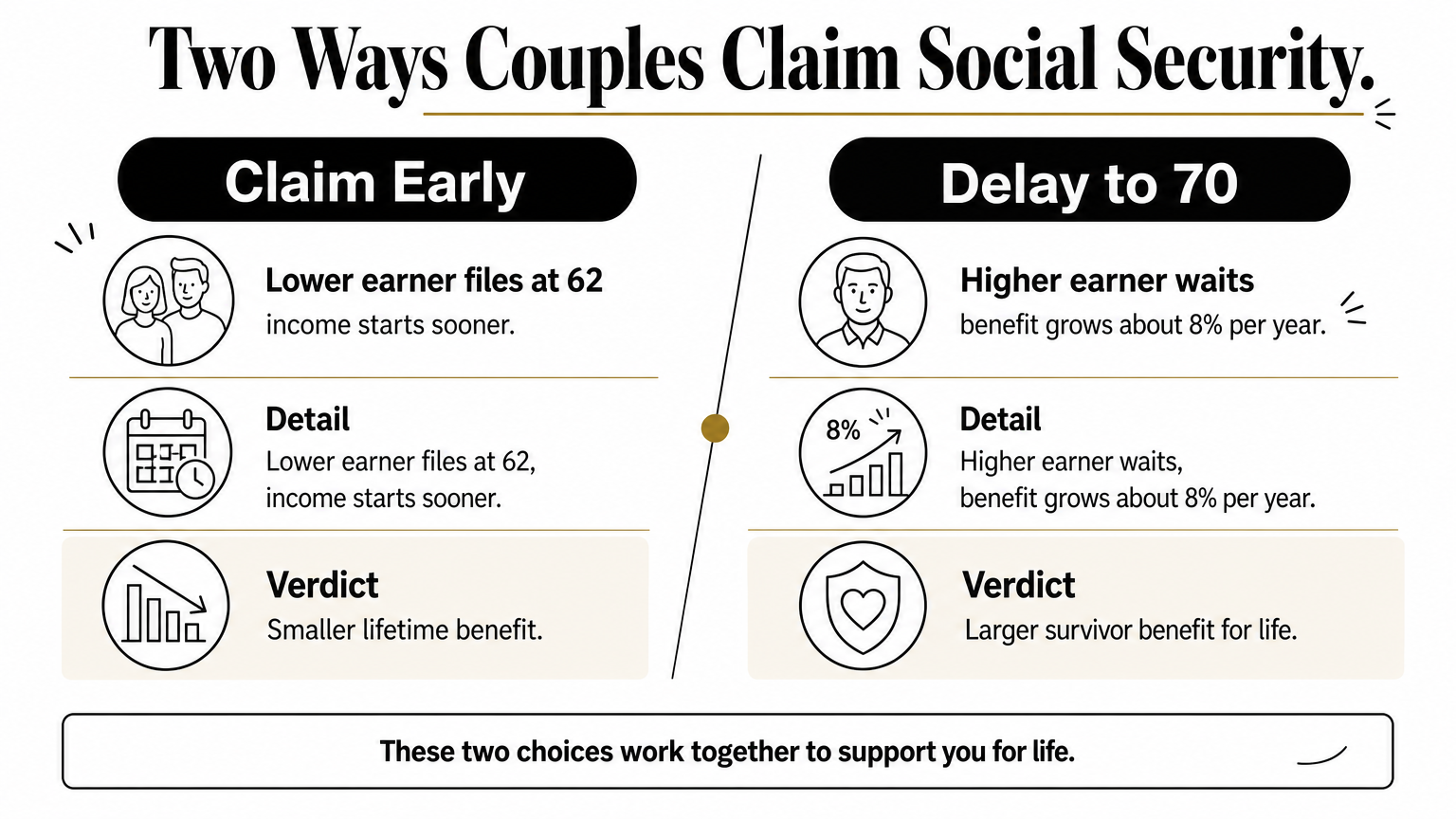
Social Security is one of the few guaranteed, inflation-adjusted income sources you’ll have in retirement, yet most couples file without ever comparing strategies. Retirement planning for couples should include a joint claiming decision, since one spouse’s choice directly affects the other’s survivor benefit down the road. Should you file for social security benefits early at 62 or wait? It is a complicated decision that depends on your own personal situation, your own financial plan and your own thoughts about longevity.
Why it matters
Each spouse’s benefit grows roughly 8% a year for every year they delay claiming past full retirement age, up until age 70. Spousal benefit rules let the lower earner claim up to 50% of the higher earner’s full retirement age benefit, and survivor benefits let the surviving spouse step up to the higher of the two benefits after a partner passes. That means the higher earner’s claiming age often matters more than either partner realizes, since it sets the floor for whichever spouse lives longer.
The highest earner’s claiming decision is really a decision about how much income the surviving spouse will live on for the rest of their life.
How to make it work as a couple
Run the numbers on a few filing combinations before deciding:
- Higher earner delays to 70, lower earner files earlier. Maximizes the survivor benefit while bringing in some income sooner.
- Both file at full retirement age. A middle-ground approach that balances current income against long-term growth.
- Both delay to 70. Best for couples with other income sources who can bridge the gap and want maximum lifetime benefits.
Use the Social Security Administration’s own benefit calculators to model your specific numbers, since estimates based on age and earnings alone miss details like earnings records and benefit history. Factor in health and family longevity honestly. A couple with a family history of illness may lean toward earlier claiming, while healthy couples with longevity in their genes usually benefit from delaying. Studdard Financial’s retirement planning process includes Social Security Maximization Plan and Timing Analysis as part of the broader plan, so the decision fits your full financial picture rather than being made in isolation.
5. Plan together for healthcare and long-term care costs
If you do plan to take social security early, make sure you plan for a health insurance gap as you probably won’t be eligible for Medicare until you are 65. I find that healthcare is the expense couples underestimate most, and it’s rarely split evenly between partners. Retirement planning for couples has to account for two different health histories, two different Medicare timelines if your birthdays fall in different years, and the real chance that one spouse will need long-term care the other can’t provide alone. Treating healthcare as a line item you’ll figure out later leaves the healthier spouse exposed financially and emotionally.
Why it matters
Fidelity estimates a 65-year-old couple retiring today will spend roughly $330,000 on healthcare throughout retirement, and that figure doesn’t include long-term care. Long-term care costs hit even harder: a private room in a nursing home now averages over $129,000 a year according to CareScout’s cost of care data, and most of that isn’t covered by Medicare. When one spouse needs extended care, the other often becomes the caregiver, the bill payer, or both, sometimes while still managing their own health.
The spouse who stays healthy longer is usually the one who ends up managing the bills, the caregiving, and the budget alone.
How to make it work as a couple
Address these questions together before either of you needs care, not during a crisis:
- Compare Medicare timelines. If your ages differ, map out when each of you becomes eligible and how you’ll bridge any coverage gap.
- Decide on long-term care funding. Options include dedicated insurance, self-funding through savings, or a hybrid life insurance policy with a long-term care rider.
- Talk about caregiving preferences. Discuss honestly whether either of you expects the other to provide hands-on care, and what happens if that’s not realistic.
Building these costs into your comprehensive financial plan, rather than treating them as a future surprise, keeps one health event from derailing decades of careful saving. As a fee-only fiduciary and CERTIFIED FINANCIAL PLANNER® professional Studdard Financial factors healthcare and long-term care scenarios into the numbers from the start, so neither spouse is left guessing later.
6. Agree on your retirement lifestyle and spending priorities
Retirement isn’t just a number in an account, it’s how you’ll spend your days once the paycheck stops. Retirement lifestyle planning forces couples to name what they actually want their weeks to look like, and that conversation often reveals gaps nobody noticed during decades of working around each other’s schedules. One partner picturing frequent travel and dinners out looks very different, financially, from one imagining quiet mornings at home and a modest garden.
Why it matters
Spending priorities drive your budget more than almost any other single decision. Lifestyle spending gaps show up when one spouse assumes a $60,000 annual budget covers everything, while the other has been mentally planning international trips and a new boat. Neither is wrong, but without agreement, someone ends up disappointed or the plan runs short. Unspoken assumptions about golf memberships, hobbies, or how often you’ll eat out can throw off even a well-funded retirement plan within a few years.
A retirement budget only works when both partners actually agree on what it’s supposed to pay for.
How to make it work as a couple
Sit down separately and each list your top five priorities for how you want to spend your time and money in retirement. Compare lists together, since overlap and gaps both matter here.
- Rank shared priorities first. Travel, hobbies, family time, or relocation often top both lists, so start budgeting there.
- Negotiate the differences. If one wants a lake house and the other wants annual cruises, decide together which fits the budget, or how to phase both in over time.
- Build a spending plan around actual priorities, not a generic retirement budget template that ignores what makes retirement worth having for each of you.
Revisit this list every couple of years. Priorities shift once retirement actually starts, and a plan built once at 60 rarely matches what a couple wants at 68. Studdard Financial’s ongoing retirement plan review builds this kind of lifestyle check into the plan itself, so spending stays aligned with what you both actually value.
7. Talk about supporting kids, grandkids, or other family
Many couples enter retirement still writing checks to adult children, helping with a grandchild’s tuition, or covering a parent’s care costs. Family financial support rarely gets a formal place in the retirement plan, yet it quietly shapes spending for years. If one partner assumes that help stops at retirement while the other plans to keep contributing indefinitely, that mismatch surfaces at the worst possible time, usually when the money is already spent.
Why it matters
Ongoing support to family members competes directly with your own retirement income, and it’s easy to underestimate how much it adds up over a decade or two. Multigenerational financial obligations also carry emotional weight that pure numbers don’t capture. Saying no to a struggling adult child feels different than trimming a travel budget, and couples who haven’t agreed on limits ahead of time often end up resentful or in conflict when a request comes in. A parent who needs care can add another layer entirely, since one spouse may feel obligated to help while the other worries about the strain on shared retirement funds.
Money you haven’t agreed to give away is money you’re still counting on for your own retirement.
How to make it work as a couple
Discuss these questions honestly before a request lands in your inbox, not after:
- Set a family support budget. Decide together on an annual dollar amount you’re comfortable giving, and stick to it as a line item rather than an open-ended promise.
- Agree on the "why." Are you funding education, helping with a down payment, or covering emergencies? Clarity here prevents scope creep.
- Plan for aging parents. Talk through what caregiving or financial support might look like on both sides of the family, since these needs often arrive unannounced.
Treat family generosity as a planned expense inside your broader financial plan, not an afterthought squeezed from whatever’s left over. Studdard Financial’s guidance on tax-efficient estate planning for retirement-focused families can help you formalize gifting limits and legacy intentions so generosity today doesn’t jeopardize security tomorrow.
8. Protect each other with estate and legal planning
No retirement plan is complete without the legal documents that back it up. Estate and legal planning for couples means more than a will split evenly between two names. It means making sure the surviving spouse can access accounts, make medical decisions, and keep the household running without a court fight during an already painful time. Couples who skip this step assume everything transfers automatically to a spouse, and that assumption is often wrong, which is why every family needs an estate plan.

Why it matters
Without updated beneficiary designations, powers of attorney, and healthcare directives, a surviving spouse can face frozen accounts, delayed claims, or a probate process that drags on for months. Beneficiary designations on retirement accounts and life insurance override whatever your will says, so an outdated form from a previous job can send assets to the wrong person entirely. A durable power of attorney and healthcare proxy let each spouse act for the other immediately if one becomes incapacitated, rather than waiting on a court-appointed guardian.
A will that only exists in a drawer protects no one when a hospital needs answers today.
How to make it work as a couple
Work through these documents together rather than assuming one spouse handles "the legal stuff":
- Update wills and trusts. Confirm both spouses’ documents reflect current wishes, especially after a move, remarriage, or new grandchild.
- Review every beneficiary form. Check 401(k)s, IRAs, and life insurance policies for outdated names, including ex-spouses.
- Sign powers of attorney and healthcare directives. Make sure both financial and medical decisions can pass to each other without delay.
Revisit these documents every few years, not just once after the wedding. Laws change, families grow, and assets shift. Studdard Financial’s estate planning services help couples coordinate these documents with their broader financial plan, so the legal side matches the numbers you’ve already agreed on together.
9. Work with a fiduciary financial advisor who understands couples
Eight conversations in, most couples realize they need a neutral third party to keep the process moving and honest. Retirement planning for couples works best with a fee-only fiduciary retirement planner in the room who has no stake in which spouse "wins" a disagreement about timing, spending, or risk. A fiduciary advisor’s only job is to serve your combined interests, not to sell a product that happens to pay a commission.
Why it matters
How advisors get paid differs depending on what they recommend, and commission-based pay quietly shapes the advice you receive even when nobody intends it. A fee-only fiduciary financial planner is legally required to put your interests first, full stop, which matters enormously when two people with different priorities are trying to reach one plan. Couples also bring different money histories into these meetings. One spouse might be the spreadsheet type, the other avoids looking at balances entirely, and an experienced advisor knows how to get both voices heard instead of letting one partner dominate the conversation.
A good fiduciary advisor doesn’t take sides between spouses, they build the plan that serves both.
How to make it work as a couple
Both partners should attend every meeting, not just the one who "handles the finances." Ask any advisor you’re considering these questions directly:
- Are you a fee-only fiduciary, and can you put that in writing? (How to choose a fee-only advisor you can trust covers what a good answer sounds like.)
- How many couples do you actively work with, versus individual clients?
- How do you handle disagreements between spouses on timing or spending?
Credentials matter here too. Byron Studdard has worked as a CFP® professional since 1993, and Studdard Financial operates as a fee-only fiduciary specifically so advice isn’t colored by commissions. If you’re ready to bring both voices to the table, schedule a consultation and start building a plan that reflects what you both actually want from retirement, not just what one spreadsheet says.
Moving Forward Together
None of these nine tips work in isolation. Retirement timing affects Social Security strategy, which affects healthcare coverage, which affects where you can afford to live. Retirement planning for couples succeeds when you treat it as one connected plan instead of nine separate decisions made by two separate people. The couples who retire well aren’t the ones with the biggest portfolios, they’re the ones who talked honestly, adjusted their assumptions, and revisited the plan as life changed.
Start with one conversation this week. Pick the tip that feels most overdue, whether that’s naming a retirement date or finally updating a beneficiary form, and talk it through together. Shared clarity now saves you from expensive surprises later. When you’re ready for a second opinion grounded in three decades of fiduciary experience, book a one-time consultation with a fee-only fiduciary financial planner and start building a retirement plan that actually reflects both of your goals.
About Byron L. Studdard, CFP®**
Byron L. Studdard is a CERTIFIED FINANCIAL PLANNER® professional and the founder of Studdard Financial – a fee-only fiduciary registered investment adviser serving clients from coast to coast from offices in Sarasota, FL and Germantown (Memphis), TN. For more than thirty years, he has provided personalized investment advice, retirement planning guidance, social security maximization strategies, and intergenerational wealth-transfer support to clients seeking disciplined, trustworthy financial oversight. His writing has been featured on the websites of ABC News, Good Morning America, and Yahoo. He can be reached at Byron@StuddardFinancial.com.
Important Disclosures:
All information provided is for educational purposes only and does not constitute investment, legal or tax advice; an offer to buy or sell any security or insurance product; or an endorsement of any third party or such third party’s views. The information contained herein has been obtained from sources we believe to be reliable but is not guaranteed to be accurate or complete. Studdard Financial, LLC does not offer tax or legal advice, but might refer clients to independent accounting, tax, or legal professionals.
Whenever there are referrals to other professional advisors, or references or hyperlinks to third-party content (including but not limited to tax and legal), this is intended to provide additional perspective and should not be construed as an endorsement of any services, products, guidance, individuals, or points of view. All examples are hypothetical and for illustrative purposes only. Please contact us for more complete information based on your personal circumstances and to obtain personal individual investment advice.
Carefully consider your investment objectives, risk factors, and charges and expenses before investing. Investing involves risk, including possible loss of principal. Consult your own advisor about the implications of investing. Diversification and asset allocation may not protect against market risk. Past performance is never a guarantee of future returns. Investing in foreign stock markets involves additional risks, such as the risk of currency fluctuations.
Not FDIC Insured No Bank Guarantee May Lose Value
Copyright Studdard Financial © 2026 · All Rights Reserved