
If your income puts you above the Roth IRA limits, you’ve probably assumed you’re locked out of tax-free retirement growth. You’re not. A backdoor Roth IRA conversion is a legal, IRS-sanctioned workaround that lets high earners fund a Roth account even when their paycheck disqualifies them from contributing directly. Many business owners and executives use this strategy every year, and current law allows this, though Congress has proposed closing it in the past.
Here’s the short answer: you contribute to a nondeductible traditional IRA, then convert those funds to a Roth IRA. Done correctly, you owe little to no tax on the conversion. But the mechanics matter. Skip a step or ignore the pro-rata rule, and you could trigger an unexpected tax bill.
This article walks through exactly how the process works, the backdoor Roth IRA conversion rules you need to follow, and the tax traps that catch people off guard. We’ll also cover who this strategy actually makes sense for, so you can decide whether it belongs in your retirement plan or whether your situation calls for a different approach.
Why high earners turn to a backdoor Roth IRA conversion
Income limits that trigger the workaround
Congress capped Roth IRA contributions at certain income levels for a reason: the tax-free growth is valuable enough that lawmakers didn’t want everyone piling in unlimited amounts. For 2025, the phase-out range sits around $150,000 to $165,000 in modified adjusted gross income for single filers, and roughly $236,000 to $246,000 for married couples filing jointly, according to the IRS. Cross that threshold and you can’t contribute to a Roth IRA directly, full stop. That’s the exact wall the backdoor Roth IRA conversion strategy is built to get around.
| Filing Status | 2025 MAGI Phase-Out Range |
|---|---|
| Single or Head of Household | $150,000 – $165,000 |
| Married Filing Jointly | $236,000 – $246,000 |
| Married Filing Separately | $0 – $10,000 |
Notice that traditional IRA deductions phase out around similar income levels too, but there’s no income cap on making nondeductible traditional IRA contributions or on converting those funds to a Roth. That gap in the rules is exactly what makes the backdoor approach work.
The tax-free growth argument
Once money lands inside a Roth IRA, it grows without ever facing capital gains or income tax again, assuming you follow the withdrawal rules. Compare that to a taxable brokerage account, where dividends and gains get taxed year after year, or a traditional IRA, where every dollar you pull out in retirement counts as ordinary income. For someone in their peak earning years who expects to stay in a high tax bracket for decades, locking in tax-free growth now can be worth far more than the modest hassle of running a conversion each year.
A backdoor Roth conversion trades a small paperwork step today for decades of tax-free compounding tomorrow.
There’s also the required minimum distribution (RMD) angle. Traditional IRAs force you to start withdrawing money at 73, whether you need the cash or not, and every withdrawal is taxable. Roth IRAs carry no RMDs during the original owner’s lifetime, which means the money can keep compounding untouched for as long as you want, or pass to heirs with more flexibility.
Who this strategy is built for
Not everyone needs this maneuver, but a specific group benefits consistently:
- Business owners and executives whose income routinely exceeds the Roth phase-out range
- Dual-income professional households pushed over the limit by combined earnings
- Savers who’ve already maxed out their 401(k) and want another tax-advantaged bucket
- Anyone expecting to stay in a high tax bracket through retirement, making tax-free withdrawals more valuable than tax-deferred ones
- Younger high earners with decades left for tax-free compounding to work in their favor
At Studdard Financial, this is one of the more common questions we field during retirement planning conversations with clients who’ve outgrown the standard contribution rules but still want Roth exposure in their portfolio.
How to complete a backdoor Roth IRA conversion step by step
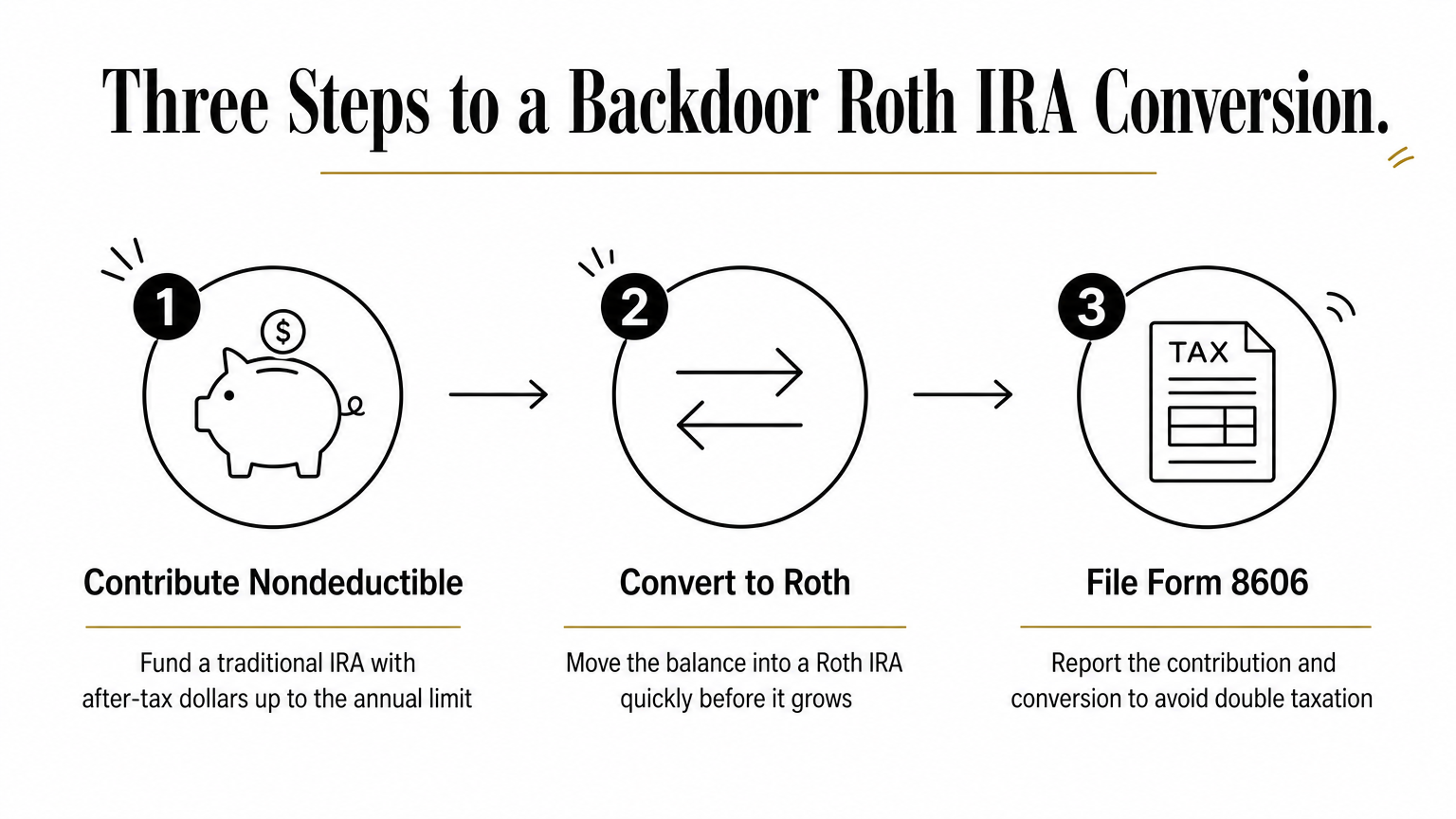
Running a backdoor conversion Roth IRA strategy
takes three moves, and each one has a specific IRS form or account type attached to it. Miss one, and you either owe tax you didn’t expect or end up with a paper trail that doesn’t match what actually happened. Here’s the sequence most advisors, including our team at Studdard Financial, walk clients through every year.
Step 1: Contribute to a nondeductible traditional IRA
Start by opening a traditional IRA if you don’t already have one, then make a nondeductible contribution up to the annual limit ($7,000 for 2025, or $8,000 if you’re 50 or older). Because your income is too high to deduct the contribution, you’re funding this account with after-tax dollars from the start. That detail matters later, since it determines how much of the conversion is taxable.
Step 2: Convert the funds to a Roth IRA
Once the contribution clears, ask your custodian to convert the traditional IRA balance into a Roth IRA. Many people do this within days of contributing, before any investment growth accumulates, since growth inside the traditional IRA before conversion gets taxed as ordinary income.
Convert quickly, before your money has time to grow, and you keep the tax bill close to zero.
Step 3: File Form 8606 with your tax return
Without this filing, the IRS has no record that you already paid tax on the contribution, and you risk being taxed twice on the same dollars.
- Report the nondeductible contribution on Part I of Form 8606
- Report the conversion amount on Part II
- Keep copies with your tax records indefinitely, since you’ll reference prior-year basis for years to come
Finishing these three steps completes a backdoor Roth IRA conversion, but the outcome depends heavily on whether you hold other pre-tax IRA money, which the next section covers in detail.
Backdoor Roth IRA conversion rules and tax implications
The pro-rata rule can wreck your math
Most people who get burned by a backdoor Roth IRA conversion strategy never even opened a second account. They already had money sitting in a SEP IRA, SIMPLE IRA, or an old rollover IRA from a previous job. The IRS doesn’t let you cherry-pick which dollars convert tax-free. Instead, the pro-rata rule treats every traditional, SEP, and SIMPLE IRA you own as one combined pot when calculating how much of a conversion is taxable.
The pro-rata rule doesn’t care which account you opened yesterday, it looks at every pre-tax IRA dollar you own today.
| Scenario | Pre-Tax IRA Balance | Nondeductible Contribution | Taxable Portion of Conversion |
|---|---|---|---|
| No other IRAs | $0 | $7,000 | ~0% |
| Old rollover IRA | $93,000 | $7,000 | 93% |
Avoiding this trap usually means rolling existing pre-tax IRA balances into an employer 401(k) before you convert, since 401(k)s aren’t counted in the pro-rata calculation.
The five-year clock and withdrawal rules
Once converted funds sit in the Roth, a separate five-year rule governs when you can pull out the converted principal without a 10% penalty, even though the contribution itself was already taxed. Each conversion starts its own five-year clock, so if you’re running this strategy annually, you’re tracking multiple clocks at once. Earnings on the converted money follow a stricter standard: you need to be 59 and a half and have held any Roth IRA for five years to make tax-efficient retirement withdrawals of those earnings.
Reporting requirements you can’t skip
Beyond Form 8606, keep records of your account basis every year, because a missed filing in one year compounds confusion in every year after it. Tax software often mishandles backdoor conversions if you enter the contribution and conversion in the wrong fields, so double-check the numbers against your 1099-R and 5498 forms before filing.
Weighing the pros and cons before you convert
Every financial strategy has a cost side, and the backdoor Roth IRA conversion strategy is no exception. Before you commit to running this every year, it helps to line up when a Roth IRA conversion can pay off against what you give up, especially since the calculus changes depending on your existing IRA balances and how close you are to retirement.
The case for converting
Getting money into a Roth IRA when you’d otherwise be shut out gives you a permanent tax-free bucket that no future tax hike can touch. It also sidesteps required minimum distributions entirely, so the funds keep compounding for as long as you want, or pass to your heirs through a tax-efficient estate plan without forcing a taxable withdrawal schedule. For business owners already maxing out a 401(k), this is often the only remaining tax-advantaged space left to fill.
The biggest upside isn’t the tax break today, it’s never having to pay tax on that money again.
The case for caution
The downside shows up in complexity and timing risk. Filing Form 8606 incorrectly, forgetting a prior-year basis, or tripping the pro-rata rule can turn a tax-free move into a taxable one. There’s also opportunity cost if you have other pre-tax IRA money that would need rolling into a 401(k) first, which isn’t always available or advisable depending on the plan’s investment options and fees.
| Factor | Works in Your Favor | Works Against You |
|---|---|---|
| Other pre-tax IRA balances | None | Large rollover or SEP balance triggers pro-rata tax |
| Time horizon | 15+ years until retirement | Near-retirement, limited compounding runway |
| Tax bracket expectation | Expect higher bracket later | Expect lower bracket in retirement |
| Paperwork tolerance | Comfortable tracking basis annually | Prefer simple, low-maintenance accounts |
Weighing these factors isn’t a one-time exercise. Your income, account balances, and retirement timeline shift every year, which means the right call this year might not hold up in five years. That’s exactly why this decision benefits from coordinated retirement tax planning strategies and a second set of eyes rather than a DIY spreadsheet guess.
Mega backdoor Roth and other options worth knowing
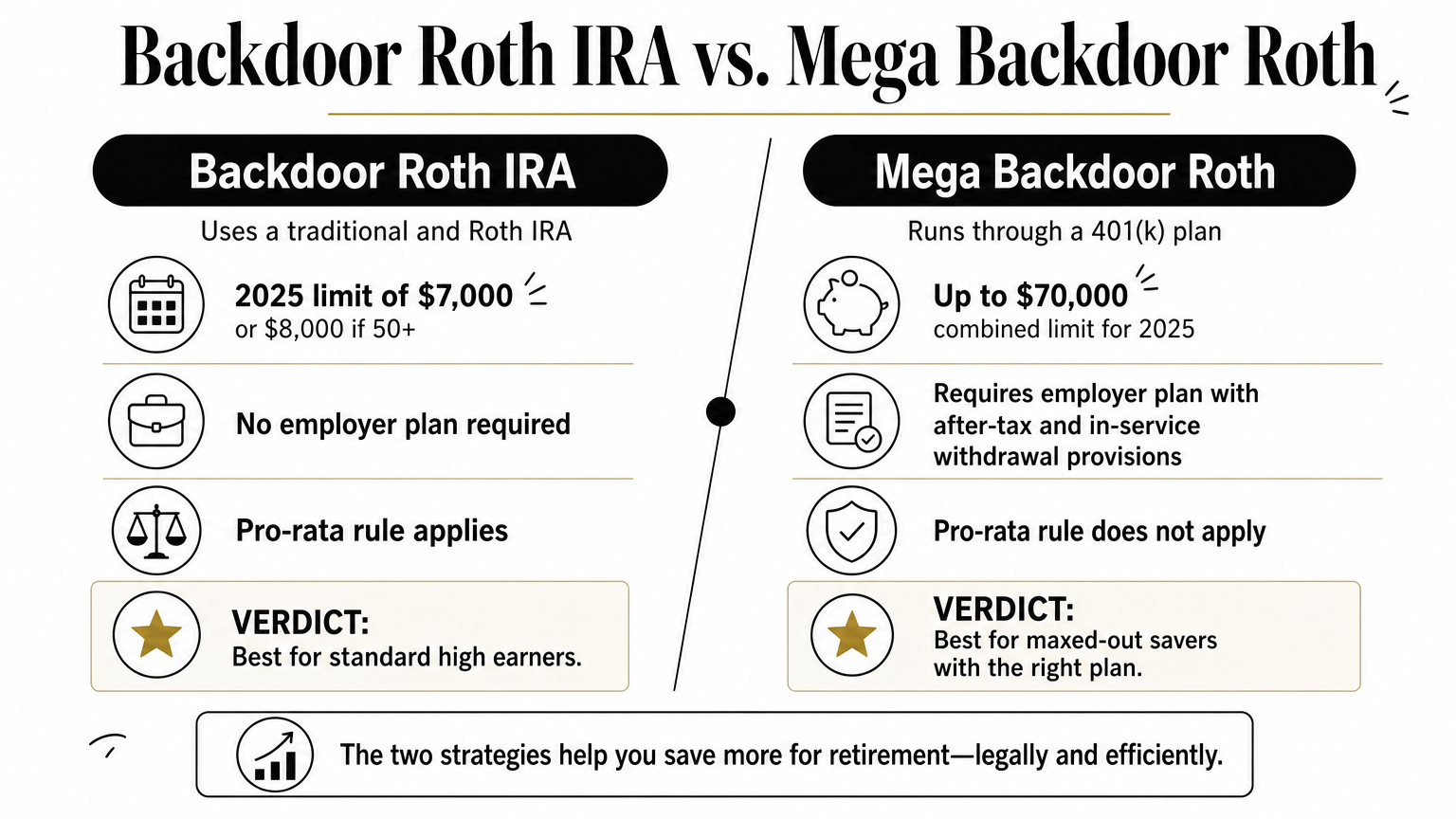
Once you’ve maxed the regular backdoor Roth IRA conversion, some savers still have room to shelter more money, and that’s where the mega backdoor Roth comes in. It’s a completely separate mechanism that runs through your 401(k) plan rather than an IRA, and it only works if your employer’s plan document allows after-tax contributions and in-service withdrawals or conversions.
The mega backdoor Roth explained
Here’s how it works: beyond your regular elective deferral, you contribute after-tax dollars directly into your 401(k), then convert those after-tax dollars to a Roth account, either inside the plan or by rolling them into a Roth IRA. For 2025, the combined employee-plus-employer limit sits at $70,000, which leaves a meaningful gap above the standard $23,500 deferral cap for after-tax contributions to fill.
The mega backdoor Roth turns unused 401(k) space into a second Roth pipeline, but only if your plan document allows it.
| Feature | Backdoor Roth IRA | Mega Backdoor Roth |
|---|---|---|
| Account used | Traditional and Roth IRA | 401(k) plan |
| 2025 contribution room | $7,000 ($8,000 if 50+) | Up to $70,000 combined limit |
| Employer plan required | No | Yes, with after-tax and in-service withdrawal provisions |
| Pro-rata rule applies | Yes | No |
Other alternatives to consider
Several other moves fit alongside or instead of a backdoor conversion to Roth IRA, depending on what your plan offers and how much complexity you’re willing to manage:
- Spousal backdoor Roth, which lets a nonworking or lower-earning spouse fund their own IRA and convert it, doubling your household’s tax-free space
- Roth 401(k) contributions, which skip the conversion step entirely if your employer offers them, though they don’t solve the IRA income cap directly
- Taxable brokerage investing in tax-efficient index funds, useful once you’ve exhausted every tax-advantaged option available to you
Each of these carries its own tradeoffs, and stacking multiple strategies at once is exactly the kind of work our team handles inside comprehensive financial planning engagements at Studdard Financial.
Deciding if this strategy fits your retirement plan
A backdoor Roth IRA conversion works well when you understand the mechanics and follow through on the paperwork every single year. Skip the pro-rata check or forget Form 8606, and you turn a smart tax move into a headache with the IRS. The strategy rewards people who value tax-free growth, want to sidestep required minimum distributions, and are willing to track basis carefully over time.
Getting this right depends on your full financial picture, including other IRA balances, your current tax bracket, and how many years you have left before retirement. Guessing at the numbers or copying what a coworker did rarely ends well when the rules are this unforgiving.
If you’re weighing whether this backdoor Roth IRA conversion strategy belongs in your plan, talk it through with someone who does this work daily. Reach out to Studdard Financial for a retirement plan review that protects your future, and we’ll walk through your numbers together.
About Byron L. Studdard, CFP®**
Byron L. Studdard is a CERTIFIED FINANCIAL PLANNER® professional and the founder of Studdard Financial – a fee-only fiduciary registered investment adviser serving clients from coast to coast from offices in Sarasota, FL and Germantown (Memphis), TN. For more than thirty years, he has provided personalized investment advice, retirement planning guidance, social security maximization strategies, and intergenerational wealth-transfer support to clients seeking disciplined, trustworthy financial oversight. His writing has been featured on the websites of ABC News, Good Morning America, and Yahoo. He can be reached at Byron@StuddardFinancial.com.
Important Disclosures:
All information provided is for educational purposes only and does not constitute investment, legal or tax advice; an offer to buy or sell any security or insurance product; or an endorsement of any third party or such third party’s views. The information contained herein has been obtained from sources we believe to be reliable but is not guaranteed to be accurate or complete. Studdard Financial, LLC does not offer tax or legal advice, but might refer clients to independent accounting, tax, or legal professionals.
Whenever there are referrals to other professional advisors, or references or hyperlinks to third-party content (including but not limited to tax and legal), this is intended to provide additional perspective and should not be construed as an endorsement of any services, products, guidance, individuals, or points of view. All examples are hypothetical and for illustrative purposes only. Please contact us for more complete information based on your personal circumstances and to obtain personal individual investment advice.
Carefully consider your investment objectives, risk factors, and charges and expenses before investing. Investing involves risk, including possible loss of principal. Consult your own advisor about the implications of investing. Diversification and asset allocation may not protect against market risk. Past performance is never a guarantee of future returns. Investing in foreign stock markets involves additional risks, such as the risk of currency fluctuations.
Not FDIC Insured No Bank Guarantee May Lose Value
Copyright Studdard Financial © 2026 · All Rights Reserved