
Most people put off planning for retirement until a birthday or a market scare forces the issue. By then, you’ve lost years you can’t get back. Whether you’re 28 or 58, the math works the same way: the earlier you build a strategy, the less you have to save each month to hit your number, and the more room you have to recover from mistakes.
This guide gives you a straight answer to the question you’re actually asking: how do I build retirement income that lasts, starting from where I stand right now. You’ll walk through how to size up your savings gap, choose investment planning for retirement that matches your timeline, and adjust your approach as you move from your 30s into your 60s.
We’ll cover when to start planning for retirement (spoiler: today, regardless of your age), practical strategies for retirement planning that account for taxes and Social Security, and how to turn scattered accounts into one coordinated plan. If you’re new to this or picking it back up after years of neglect, start with what retirement planning actually covers and you’ll leave with a clear next step instead of more open tabs.
When to start planning for retirement
The honest answer is: as soon as you have your first paycheck. But that answer doesn’t help you if you’re 45 and haven’t opened a statement in five years, so let’s break it down by decade, since retirement strategies shift with each age group. When should you start planning for retirement matters less than what you do next, but the timeline changes your options considerably. Someone in retirement planning for beginners mode at 25 has different tools available than someone doing retirement planning for seniors at 68, and pretending otherwise wastes your time.
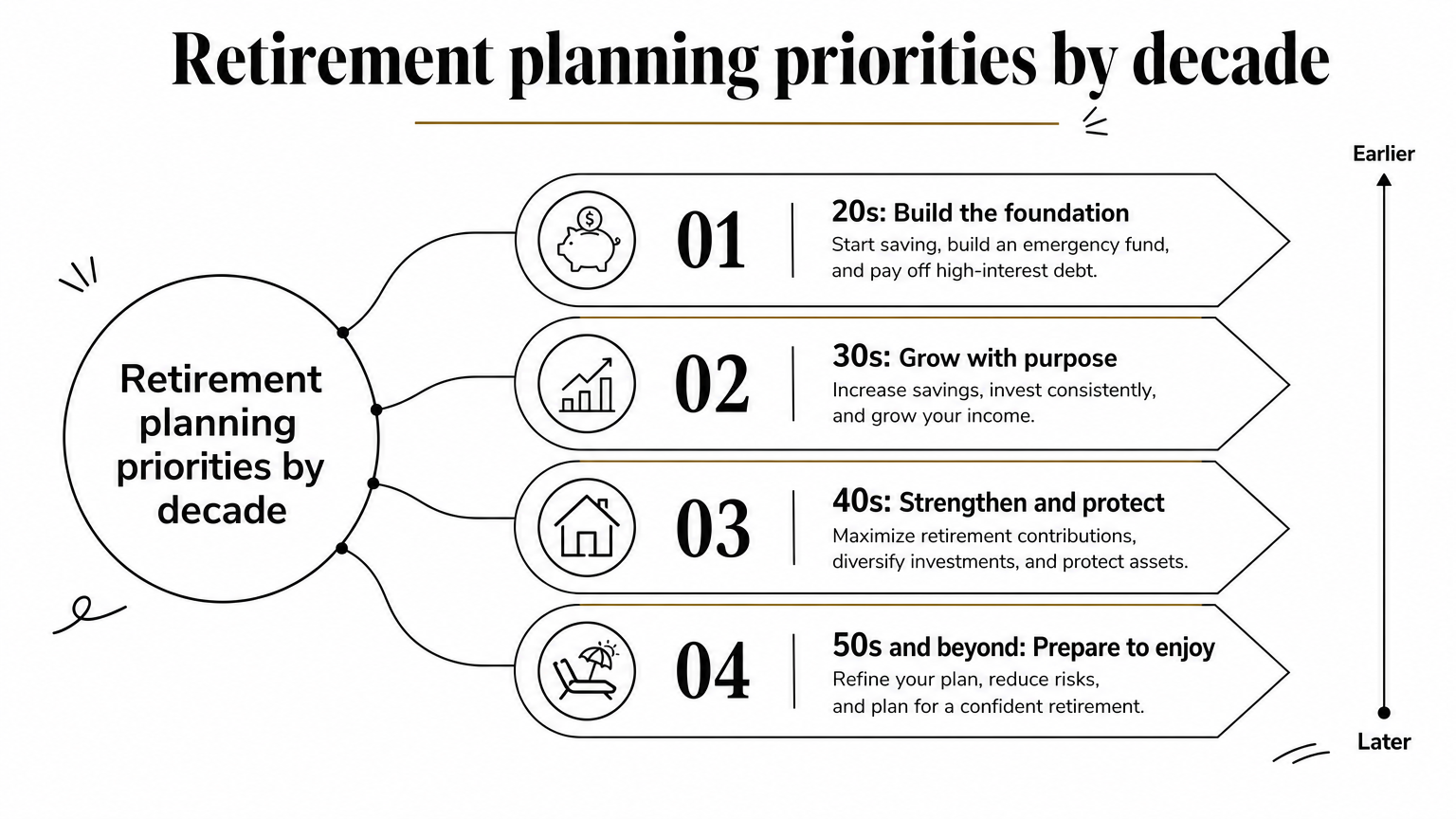
The single biggest lever in retirement planning isn’t your income, it’s the number of years your money has to compound.
In your 20s and 30s: build the habit, not the perfect plan
You don’t need a sophisticated strategy at this stage. You need a habit. Contribute enough to your employer’s 401(k) to capture the full match, that’s free money and an instant return no market can beat. Open a Roth IRA if your income qualifies, since decades of tax-free growth on contributions made now will matter more than almost any other decision you make. If you’re carrying high-interest debt, split your focus, but don’t wait until you’re debt-free to start saving. A $200 monthly contribution at 25 outgrows a $500 monthly contribution started at 40, assuming a 7% average return, simply because time does the heavy lifting.
I know that some will push back on the math of this, but I’ve seen too many people finally get debt free and because they didn’t build the habit, they run the credit cards back up before their savings amount to much. In my experience, if I can get someone to get excited about seeing how much their money makes for them each month, it helps them to not run up the cards again. Not everyone is the same, so know your self and decide how much to debt and how much to save – but start building that habit.
In your 40s: closing the gap between saving and doing
Midlife brings competing demands, kids’ college costs, aging parents, mortgages, and it’s easy to let retirement contributions stagnate. This is the decade to run real numbers instead of vague hopes. Pull your Social Security estimate from ssa.gov, tally your current account balances, and calculate what you’d need to retire on your own terms rather than by default. If you’re behind, this is also when catch-up strategies start to matter, since the IRS raises contribution limits as you approach 50. Treat your 40s as the decade for course correction, not the decade to coast.
In your 50s: catch-up contributions and getting specific
Once you turn 50, the IRS lets you contribute more to your 401(k) and IRA each year, and catch-up contributions in your 50s are worth every dollar of that room if you can use it. This is also the point where a written plan, not just a savings target, becomes essential. You need to know your expected retirement age, your expected expenses, and how your assets are allocated across taxable, tax-deferred, and tax-free accounts. Working with a fee-only fiduciary advisor at this stage often pays for itself, since the decisions you make in your 50s about asset allocation and Social Security timing are harder to reverse than the ones you made in your 30s.
In your 60s and beyond: sequencing and income, not just accumulation
By your 60s, the goal shifts from growing your balance to turning savings into a steady paycheck. This is where planning for retirement income replaces simple saving as the priority, and where decisions about when to take Social Security benefits, Medicare enrollment, and required minimum distributions all start to interact. Even retirees who’ve done everything right often need help sequencing withdrawals to avoid unnecessary taxes.
| Life stage | Primary focus | Key action |
|---|---|---|
| 20s-30s | Build the savings habit | Capture full employer match, open a Roth IRA |
| 40s | Close the gap | Estimate Social Security, calculate real retirement number |
| 50s | Catch up and get specific | Max out catch-up contributions, formalize a written plan |
| 60s+ | Convert savings to income | Sequence withdrawals, coordinate Social Security and Medicare |
No matter which row you’re in, the fix is the same: stop treating retirement as a someday problem and start treating it as a today decision. The next eight steps show you exactly how.
Step 1. Set clear retirement goals
Before you calculate a single number, decide what retirement actually looks like for you. Vague goals like "I want to retire comfortably" don’t give you anything to plan against. Clear retirement goals turn an abstract fear into a set of decisions you can act on now, and they’re the foundation every later step in this guide depends on. Skip this step and you’ll end up guessing at savings targets instead of building toward a real number.
Picture your actual retirement, not a generic one
Start by getting specific about the life you want to fund. Do you plan to relocate, downsize, or stay in your current home? Will you travel heavily in the first five years and slow down later, or keep working part-time out of choice rather than necessity? These answers change your retirement income needs by tens of thousands of dollars a year, so don’t skip past them to get to the spreadsheet faster.
A retirement plan built without a clear picture of your future life is just a savings account with a deadline.
Set a target date, and treat it as flexible
Pick a target retirement age, even if you expect it to shift. This single decision drives your savings rate, your Social Security claiming strategy, and your investment timeline, so it belongs at the top of any retirement planning guide you build for yourself. If you’re not sure, run two scenarios, one at 62 and one at 67, and compare what each requires before deciding whether you can retire early. Seeing the gap between those two numbers usually clarifies the decision faster than any amount of worrying.
Write your goals down where you’ll actually see them
Goals that live only in your head get quietly abandoned the first time the market drops. Put them somewhere concrete:
- Target retirement age and a backup age if things don’t go as planned
- Desired annual income in today’s dollars, not adjusted for inflation yet
- Major one-time expenses, like a home purchase, wedding, or long trip
- Legacy goals, such as leaving a set amount to children or a charity
- Non-negotiables, like staying in your current city or maintaining a specific lifestyle
Once you’ve listed these, rank them. Not every goal can be fully funded, and knowing which ones you’d trim first saves you from painful decisions later, when the pressure of an actual market downturn makes clear thinking harder. A fee-only fiduciary can help you stress-test this list against realistic numbers, but the ranking itself only you can do. With your goals on paper, you’re ready to attach real dollar figures to them, which is exactly what the next step covers.
Step 2. Estimate how much income you’ll need
Once your goals are on paper, translate them into a number. Estimating retirement income needs is where most people either overshoot with a rough guess or undershoot by forgetting a category of spending entirely. This step turns your list of goals from Step 1 into a monthly and annual figure you can actually save toward, and it’s the backbone of any solid retirement readiness planning guide.
Start with the 80% rule, then test it against your own numbers
A common shortcut says you’ll need about 80% of your pre-retirement income to maintain your lifestyle. It’s a reasonable starting point, but treat it as a rough draft, not a final answer. If your mortgage will be paid off, that percentage drops. If you plan to travel more or cover a family member’s care, it climbs. Run your own math instead of borrowing someone else’s average.
A generic income replacement percentage tells you almost nothing about your specific life; only your own expense list does.
Break your expenses into fixed and flexible costs
Separate your spending into two buckets so you know what’s negotiable and what isn’t:
- Fixed costs: housing, insurance premiums, property taxes, and minimum debt payments
- Flexible costs: travel, dining out, hobbies, and gifts to family
- Healthcare costs: premiums, out-of-pocket expenses, and an estimate for long-term care
- One-time costs: a new car, home renovation, or a grandchild’s education fund
This breakdown matters because fixed costs need guaranteed income sources, like Social Security or a pension, while flexible costs can be funded from a portfolio that carries more variability year to year.
Account for inflation before you finalize a number
Many people build a budget in today’s dollars and forget that a 25 to 30 year retirement means today’s dollars won’t stretch nearly as far by year 20. Even at a modest 3% average inflation rate, your expenses roughly double over 24 years. Build this into your projections now, not after you notice your fixed income buying less than it used to.
| Assumption | Rough result over 25 years |
|---|---|
| 2% average inflation | Expenses grow about 64% |
| 3% average inflation | Expenses roughly double |
| 4% average inflation | Expenses grow about 167% |
With a realistic income target in hand, adjusted for inflation and broken into fixed and flexible categories, you’re ready for the next question: where is that income actually going to come from. That’s what Step 3 covers, and it’s also a conversation worth having with an advisor before you commit to a number you’ll be living with for decades.
Step 3. Inventory your income sources and assets
Now that you know what you need, figure out what you already have working for you. Most people underestimate their own resources because everything sits scattered across old 401(k)s, a pension from a job they left a decade ago, and a brokerage account they forgot to consolidate. Inventorying your income sources turns that scattered picture into a single list you can measure against the target you built in Step 2, and it’s often the step that reveals you’re closer to your goal than you thought, or further behind than you assumed.

List every guaranteed income stream first
Guaranteed income covers your fixed costs, so identify it before you touch anything else. Pull your Social Security estimate directly from ssa.gov, note any pension you’re owed, and list annuity payments if you hold one. These sources matter more than their dollar amount suggests, since they don’t fluctuate with the market and reduce how much your portfolio has to generate on its own.
The income you don’t have to invent from your portfolio is the income you don’t have to worry about during a downturn.
Catalog every account, not just the ones you check often
Gather statements from every account, including the ones you haven’t logged into in years. Old employer plans, rollover IRAs, and a taxable brokerage account from a previous job all count toward your total, and each carries different tax treatment that matters later.
| Account type | Tax treatment | Typical use in retirement |
|---|---|---|
| 401(k) / Traditional IRA | Tax-deferred, taxed on withdrawal | Core retirement savings |
| Roth IRA / Roth 401(k) | Tax-free growth and withdrawal | Flexible, tax-free income later |
| Taxable brokerage | Capital gains tax on growth | Bridge income, flexible spending |
| HSA | Tax-free if used for medical costs | Healthcare and long-term care |
Don’t overlook assets that aren’t obviously "retirement" money
Beyond retirement accounts, list assets you might eventually convert to income: home equity, a business interest, cash value in a permanent life insurance policy, or a rental property. Not every asset belongs in your retirement math, but each one deserves a decision, whether that’s selling, holding, or passing it on as part of your legacy plan.
Once you’ve listed guaranteed income, account balances, and secondary assets in one place, compare the total against your Step 2 number. That gap, whether it’s a surplus or a shortfall, is exactly what Step 4 addresses, since your investment strategy for retirement should be built specifically to close it rather than copied from a generic model portfolio.
Step 4. Build an investment strategy for retirement
With your gap identified, you need a portfolio built to close it, not one copied from a magazine model or your brother-in-law’s advice. Investment planning for retirement looks different depending on how many years stand between you and your target date, and it looks different again once you’re drawing income instead of adding to a balance. The goal here isn’t to chase the highest return available; the best financial planning strategies for retirement match your risk exposure to your actual timeline and the goals you wrote down in Step 1.
Match your allocation to your timeline, not your comfort level
Many investors set their stock-to-bond mix based on how a market drop feels rather than how many years they have to recover from one. A 35-year-old with three decades until retirement can absorb a 30% downturn without changing the outcome much. A 63-year-old two years from retiring might not be able to, especially if that downturn hits right before they need to start withdrawing. Age-based rules of thumb, like subtracting your age from 110 to get your stock percentage, offer a rough starting point, but it’s worth defying conventional wisdom so your actual investment for retirement planning decision accounts for your guaranteed income from Step 3 as well. More guaranteed income generally means you can tolerate more equity risk in the rest of your portfolio.
The right allocation isn’t the one with the best historical return, it’s the one you can hold through a bad year without changing your plan.
Diversify across account types, not just asset classes
Spreading your money across stocks, bonds, and cash matters, but spreading it across tax treatments matters just as much. Holding assets in taxable, tax-deferred, and Roth accounts gives you flexibility later to control your taxable income year by year, a strategy Step 5 covers in more detail. Use this basic framework as you build:
- Growth assets (stocks, stock funds): fund your later retirement years and outpace inflation
- Stability assets (bonds, bond funds): fund your first few retirement years and help you manage sequence risk in retirement
- Cash and equivalents: cover 6-12 months of expenses so you’re never forced to sell in a downturn
Rebalance on a schedule, not on emotion
Set a rebalancing calendar, once or twice a year, and stick to it regardless of headlines. Markets drift your allocation away from your target constantly, and left unchecked, a portfolio that started at 60% stocks can quietly become 75% stocks after a strong run, exposing you to more risk than you signed up for. A written rebalancing rule removes the guesswork and keeps your strategies for retirement planning consistent even when the market makes consistency feel uncomfortable. Once your allocation reflects your actual timeline and risk capacity, the next question becomes how to withdraw from it without handing over more to taxes than necessary.
Step 5. Plan tax-efficient savings and withdrawals
How you withdraw matters almost as much as how much you saved. Tax-efficient withdrawals in retirement can stretch a portfolio for years longer than a random pull-from-whatever-account approach, and the difference compounds every year you’re retired. This step connects directly to the account mix you built in Step 4, since the accounts you diversified across now become the levers you pull to control your taxable income each year.
Know what each account costs you in taxes
Every dollar you withdraw carries a different tax bill depending on where it came from. Traditional 401(k) and IRA withdrawals count as ordinary income, taxable brokerage withdrawals trigger capital gains tax only on the growth, and Roth withdrawals come out completely tax-free if you meet the holding requirements. Lay these out side by side before you touch a single account.
| Account type | Tax on withdrawal | Best use in early retirement |
|---|---|---|
| Traditional 401(k)/IRA | Ordinary income tax | Fill low tax brackets deliberately |
| Taxable brokerage | Capital gains tax on growth only | Bridge income before Social Security |
| Roth IRA/401(k) | Tax-free | Cover income spikes without pushing brackets |
The order you withdraw from your accounts can matter as much as how much you saved into them.
Sequence withdrawals to control your tax bracket, not just your cash flow
Most retirees do better pulling from taxable accounts first, letting tax-deferred and Roth balances keep growing, then blending in tax-deferred withdrawals once taxable accounts run low. But strategies for retirement planning around sequencing aren’t one-size-fits-all. If you retire at 60 and delay Social Security to 67, that seven-year window is often your best opportunity to draw down traditional accounts at a low bracket before required distributions and Social Security both start.
Use Roth conversions during your low-income years
Once your goals are in hand, look hard at the years between retiring and claiming Social Security or hitting required minimum distribution age. Converting traditional IRA funds to a Roth during a year when your income is unusually low is one of the tax strategies for retirees that can lock in a lower tax rate permanently. This isn’t a decision to make casually; overdo a conversion and you push yourself into a higher bracket for no reason. Verify current thresholds directly at irs.gov before acting, since brackets and RMD ages shift with legislation.
Running these numbers well before you retire, rather than scrambling the year you stop working, is exactly the kind of coordinated tax planning a fee-only fiduciary builds alongside your investment strategy, not as an afterthought.
Step 6. Prepare for healthcare and long-term care costs
Healthcare is the expense category retirees underestimate most consistently, and it’s also the one most likely to derail an otherwise solid plan. Healthcare costs in retirement include Medicare premiums, deductibles, dental and vision (which Medicare mostly doesn’t cover), and the wildcard that breaks more budgets than any other: long-term care. Fidelity’s own research has pegged the average retired couple’s out-of-pocket medical costs at well over $300,000 over a retirement, and that figure doesn’t even include a nursing home stay. Build this line item into your plan now, not after a diagnosis forces the issue.

Understand what Medicare actually covers, and what it doesn’t
Medicare enrollment starts at 65, and missing your initial window can trigger permanent late-enrollment penalties, so mark that date well before you get there. Original Medicare (Parts A and B) covers hospital stays and outpatient care but leaves gaps, which is why most retirees pair it with either a Medigap policy or a Medicare Advantage plan. Neither Medicare nor Medigap covers custodial long-term care, the kind of help with daily living that makes nursing homes and assisted living so expensive. Check current enrollment rules and deadlines directly at medicare.gov before you turn 65.
The gap between what Medicare covers and what long-term care actually costs is the single biggest hole in most retirement plans.
Fund long-term care before you need it, not after
Once you understand the gap, decide how you’ll fill it. You have a handful of realistic paths, and each carries tradeoffs:
- Self-funding: setting aside a dedicated portion of your portfolio, workable if your assets are substantial
- Long-term care insurance: purchased in your 50s or early 60s while premiums and health qualification are still manageable
- Hybrid life insurance/long-term care policies: combine a death benefit with a long-term care rider
- Health savings account (HSA): if you have access to one now, its triple tax advantage makes it one of the most efficient ways to prequalify for future medical and long-term care expenses
Build a dedicated healthcare bucket into your withdrawal plan
Separating a healthcare reserve from your general spending fund keeps a bad medical year from forcing you to sell investments at the wrong time. Treat this bucket the way you’d treat an emergency fund, sized for a real event, not a hopeful estimate, and revisit it as part of the same regular review Step 8 covers next.
Step 7. Protect your legacy with estate planning
A retirement plan that ends at your own income needs is only half finished. Estate planning that protects your legacy makes sure the assets you spent decades building actually go where you intend, without unnecessary taxes, delays, or family disputes eating into what’s left. This step connects directly to the legacy goals you wrote down in Step 1, and it deserves the same attention you gave your investment allocation, not a rushed afternoon with a template you found online.
Get the core documents in place first
Before you worry about anything complex, confirm you have the basics, since every family needs an estate plan and a surprising number of people with substantial portfolios still lack these fundamentals:
- A will, naming guardians for minor children and specifying how remaining assets are distributed
- A durable power of attorney, so someone can manage your finances if you’re incapacitated
- A healthcare directive and healthcare proxy, spelling out your medical wishes and naming who decides if you can’t
- A revocable living trust, if you want to avoid probate or keep your affairs private
A will only works if it exists; an unsigned draft in a desk drawer protects no one.
Check your beneficiary designations, not just your will
Here’s a mistake that undoes even careful planning: beneficiary designations on retirement accounts and life insurance policies override what your will says. If you named an ex-spouse on a 401(k) twenty years ago and never updated it, that ex-spouse inherits the account, regardless of your current wishes. Pull every statement, from your 401(k) to your life insurance policy to your HSA, and confirm the named beneficiary matches your intent today.
Coordinate estate planning with your withdrawal strategy
Estate planning and the tax-efficient withdrawal sequencing from Step 5 aren’t separate exercises, they work together. In tax-efficient estate planning for retirement-focused families, leaving Roth assets to heirs passes on tax-free growth, while traditional IRA balances left to non-spouse beneficiaries now generally must be withdrawn within ten years under current rules, often at the heir’s own tax bracket. That timing detail can change which accounts you draw down first in retirement and which ones you preserve for planning for retirement income you’ll never personally spend. Confirm current inheritance rules directly at irs.gov, since they’ve shifted more than once in recent years.
Once your documents are current and your beneficiaries match your intentions, loop in an estate attorney to review anything involving a trust, a business interest, or a blended family situation. A fee-only fiduciary can coordinate this work alongside your broader plan, making sure your legacy goals and your income plan pull in the same direction instead of working against each other.
Step 8. Review and adjust your plan regularly
A retirement plan built once and never revisited goes stale fast. Reviewing your retirement plan on a regular schedule catches the small drifts before they become expensive problems, whether that’s an allocation that’s crept too aggressive, a beneficiary form that’s years out of date, or a spending assumption that no longer matches reality. Treat this step as ongoing maintenance, not a one-time chore you check off after Step 7.
Set a fixed review schedule and stick to it
Pick a recurring date, once a year at minimum, and treat it like any other financial deadline. Some people tie it to a birthday, others to tax season, since account statements and tax documents are already in hand. Whatever date you choose, use the same checklist every time so nothing slips through:
- Net worth and account balances, compared against last year’s numbers
- Asset allocation, checked against the target you set in Step 4
- Beneficiary designations, confirmed against your current wishes from Step 7
- Withdrawal rate, if you’re already retired, compared against your plan’s sustainable target
- Insurance and long-term care coverage, checked for lapses or outdated coverage amounts
A plan you built five years ago and haven’t touched since isn’t a plan anymore, it’s a guess with an old date on it.
Revisit your plan after major life events, not just on schedule
Beyond the annual check-in, certain events demand an immediate review regardless of where you are in your yearly cycle. A job change, a divorce, an inheritance, the death of a spouse, or a significant market downturn right before retirement all warrant pulling out the plan and running the numbers again. Waiting for your scheduled review after one of these events risks locking in decisions, like a withdrawal rate or an asset allocation, that no longer fit your actual circumstances.
Bring in a second set of eyes periodically
Even a well-built plan benefits from outside review every few years, which is why it helps to know how to choose a retirement financial planner before you miss your own blind spots. A fee-only fiduciary advisor can stress-test your retirement planning guide against updated tax law, current market conditions, and life changes you might not have connected back to your original goals. This isn’t about handing over control, it’s about confirming the plan still does what you built it to do. Reviewing regularly turns retirement planning from a project you finish once into a discipline you maintain for as long as the money needs to last, which, for most people, is decades longer than the planning itself ever takes.
Moving forward with your retirement plan
You now have the eight steps that turn planning for retirement from a vague worry into a working process: clear goals, a real income number, a full inventory of what you already have, an investment strategy built for your timeline, tax-smart withdrawals, healthcare coverage, an estate plan, and a review habit that keeps all of it current. None of these steps requires perfection on the first pass. They require you to start, then refine as your numbers and your life change.
What separates a plan that actually works from one that gathers dust is having someone check your assumptions against reality before a mistake becomes permanent. If you’d rather talk through your specific numbers with a fee-only fiduciary retirement planner than keep guessing alone, schedule a consultation with Studdard Financial and get a second opinion built around your goals, not a product.
About Byron L. Studdard, CFP®**
Byron L. Studdard is a CERTIFIED FINANCIAL PLANNER® professional and the founder of Studdard Financial – a fee-only fiduciary registered investment adviser serving clients from coast to coast from offices in Sarasota, FL and Germantown (Memphis), TN. For more than thirty years, he has provided personalized investment advice, retirement planning guidance, social security maximization strategies, and intergenerational wealth-transfer support to clients seeking disciplined, trustworthy financial oversight. His writing has been featured on the websites of ABC News, Good Morning America, and Yahoo. He can be reached at Byron@StuddardFinancial.com.
Important Disclosures:
All information provided is for educational purposes only and does not constitute investment, legal or tax advice; an offer to buy or sell any security or insurance product; or an endorsement of any third party or such third party’s views. The information contained herein has been obtained from sources we believe to be reliable but is not guaranteed to be accurate or complete. Studdard Financial, LLC does not offer tax or legal advice, but might refer clients to independent accounting, tax, or legal professionals.
Whenever there are referrals to other professional advisors, or references or hyperlinks to third-party content (including but not limited to tax and legal), this is intended to provide additional perspective and should not be construed as an endorsement of any services, products, guidance, individuals, or points of view. All examples are hypothetical and for illustrative purposes only. Please contact us for more complete information based on your personal circumstances and to obtain personal individual investment advice.
Carefully consider your investment objectives, risk factors, and charges and expenses before investing. Investing involves risk, including possible loss of principal. Consult your own advisor about the implications of investing. Diversification and asset allocation may not protect against market risk. Past performance is never a guarantee of future returns. Investing in foreign stock markets involves additional risks, such as the risk of currency fluctuations.
Not FDIC Insured No Bank Guarantee May Lose Value
Copyright Studdard Financial © 2026 · All Rights Reserved