• Skip to primary navigation
  • Skip to main content
  • Skip to footer

Studdard Financial - Sarasota Fee Only Fiduciary CFP registered investment advisor

Fee Only Fiduciary CFP registered investment advisor

  • About Us
  • Our Services
  • Blog
  • Contact

Understanding Support and Resistance Lines

June 29, 2026 by Byron Studdard

Where is the stock market likely to go next?

While no indicator can predict the future with certainty, support and resistance lines provide valuable clues about where buyers and sellers are likely to step in. These price levels are among the oldest tools in technical analysis, helping investors make more informed decisions about buying, selling, and managing risk. It is important to remember that while they are reliable, they aren’t perfect. No investment philosophy or strategy can guarantee a profit or prevent a loss. Furthermore, this is only one tool of many and doesn’t take into account fundamental analysis.

Support and Resistance Lines

What Is Support?

Support is a price level where a security tends to stop falling because there are more buyers at that price than sellers. 

Think of support as a floor beneath a stock’s price. When prices decline toward this level, investors often see value and begin buying, causing the decline to slow or reverse.

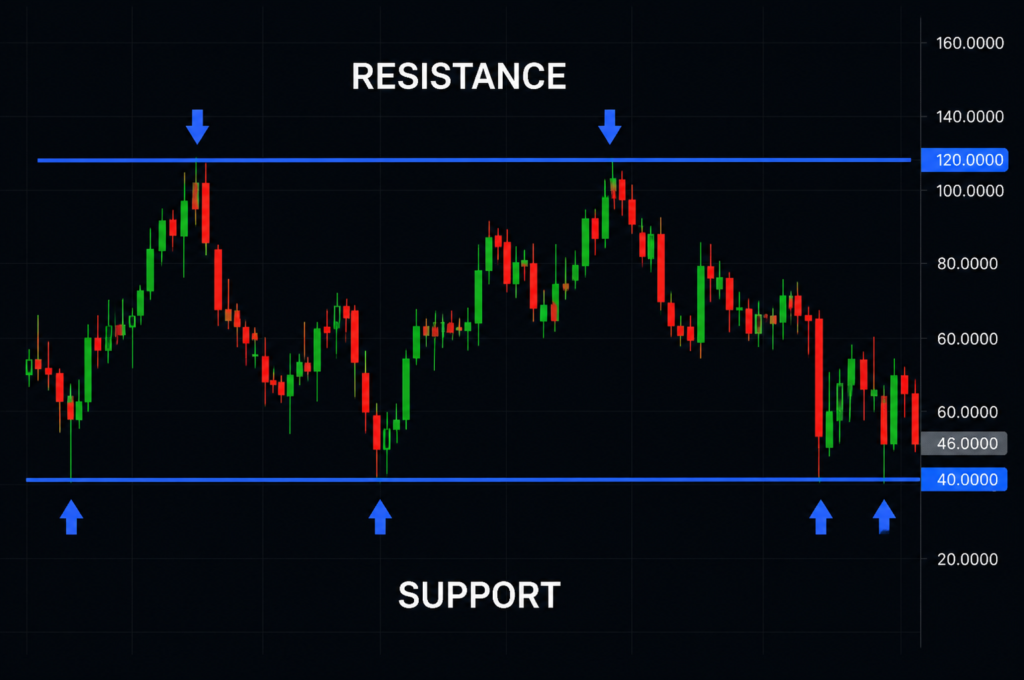
In the chart above, the stock repeatedly bounces near $40, so many traders would refer to that as a floor of support.

Why Support Matters

Support levels can help investors:

  • Identify potential buying opportunities
  • Set stop-loss orders below important price levels
  • Measure downside risk before entering a trade

However, support is not permanent. If the fundamentals (things like sales and earnings) decline, then the selling pressure might be great enough to break through the floor which can lead to a sharp move lower.


What Is Resistance?

Resistance is the opposite of support.

It is a price level where upward momentum slows because there are more sellers than buyers. Investors who bought at lower prices may begin taking profits – or even shorting the stock (betting it goes down in price).

Imagine resistance as a ceiling that the stock struggles to break through.

In the chart above, the stock repeatedly reaches $120 but fails to move higher, so many traders would refer to that as a ceiling of resistance.

Why Resistance Matters

Resistance levels help investors:

  • Identify areas to take profits
  • Avoid chasing stocks that may be overextended
  • Recognize potential breakout opportunities

When a stock finally closes above resistance on strong volume, it often signals renewed buying interest and the potential for further gains.


The Psychology Behind Support and Resistance

Support and resistance work because markets are driven by human behavior.

Investors remember important price levels.

  • Buyers remember where they previously found value.
  • Sellers remember where they experienced losses.
  • Institutions often place large orders near well-known price levels.

This collective behavior creates recurring areas where supply and demand repeatedly interact.

In many ways, support and resistance represent investor psychology made visible on a chart.


When Support Becomes Resistance

One of the most powerful concepts in technical analysis is the role reversal of price levels.

Imagine a stock falls below an important floor of support level.

Once broken, that former support often becomes new resistance. Investors who bought near the old support may sell if the stock rallies back to their entry price, creating additional selling pressure.

Likewise, when resistance is broken convincingly, it frequently becomes new support.

This transition often confirms that market sentiment has shifted.


Confirming a Breakout

Not every move above resistance—or below support—is meaningful.

False breakouts happen regularly.

Many traders look for confirmation before acting, including:

  • A strong daily or weekly close beyond the level
  • Higher-than-average trading volume
  • Fundamental improvements in the stock
  • Multiple closes above resistance
  • Momentum indicators supporting the move

The more confirmation present, the greater the probability that the breakout is genuine.


Why Volume Matters

Price tells you what happened.

Volume tells you how much conviction was behind the move.

A breakout above resistance with heavy volume suggests institutional investors are participating, increasing the likelihood that the move will continue.

Conversely, a breakout on light volume is more susceptible to failure.

Risk Management Comes First

No technical level works 100% of the time.

Markets can surprise even the most experienced investors.

Support and resistance should always be used alongside proper risk management.

Before entering any trade, consider:

  • Where will you exit if you’re wrong?
  • How much capital are you willing to risk?
  • Does the potential reward justify the risk?

Successful investing is not about being right every time—it’s about managing losses while allowing winners to grow.


Final Thoughts

Support and resistance levels are more than simple lines on a chart. They represent the ongoing battle between buyers and sellers and provide valuable insight into market psychology.

While these levels cannot predict the future with certainty, they can help investors identify high-probability entry points, manage risk, and recognize potential trend changes.

Whether you’re a long-term investor or an active trader, mastering support and resistance is one of the most valuable skills you can develop. Like any investing tool, they work best when combined with sound risk management, patience, and a disciplined investment strategy.

Investment Disclaimer

The information provided in this article is for educational and informational purposes only and should not be construed as financial, investment, tax, or legal advice. Nothing contained herein constitutes a recommendation, solicitation, or endorsement to buy, sell, or hold any security or investment. All investments involve risk, including the potential loss of principal. Past performance is not indicative of future results, and no investment strategy can guarantee profits or protect against losses in declining markets. The charts, technical analysis, support and resistance levels, moving averages, and other market observations presented are based on historical price data and are intended solely to illustrate technical analysis concepts. Market conditions can change rapidly, and technical indicators should not be relied upon as the sole basis for making investment decisions. Before making any investment decisions, you should conduct your own research, evaluate your financial situation and investment objectives, and consult with a qualified financial advisor or other licensed professional. You are solely responsible for your own investment decisions and the risks associated with them.

The author and publisher assume no liability for any losses or damages arising from the use of the information contained in this publication. You should carefully consider your risk tolerance, time horizon, and financial objectives before making investment decisions. By investing, you run the risk of losing money or losing buying power (where your money does not grow as fast as the cost of living). Investing involves risk and no investing strategy can prevent a loss or guarantee a gain, and our strategies are no different. Risk can be classified into many different categories, and by knowing those categories you can better manage expectations and avoid or reduce certain kinds of risk. This communication is meant to generally summarize the current outlook of the overall market and while it may make references to specific securities owned and/or trading strategies, theories, and philosophies, it is important to note that these are not used in every account or for every client.  You should review your own account regularly to ensure it is being managed in the way you desire.  Any performance data shown represents past performance, which is not a guarantee of future results. Investment returns and principal value will fluctuate so that investors’ shares, when sold, may be worth more or less than their original cost. Current performance may be lower or higher than the performance data cited. Artificial Intelligence (AI) is used occasionally to generate this content and the chart above was generated using AI and is of the Vanguard Total Stock Market ETF (ticker: VTI) which seeks to track the performance of the CRSP US Total Market Index including large-, mid-, and small-cap equity diversified across growth and value styles. The Center for Research in Security Prices (CRSP) is a vendor of historical time series data on securities. Academic, commercial, and government agencies use CRSP to access information such as price, dividends, and rates of returns on stocks. The FDIC does not insure money invested in stocks, bonds, mutual funds, or municipal securities.   

Investment Advisory products/services are offered through Studdard Financial, LLC, a registered investment advisor. By industry regulation, we cannot accept time-sensitive information or orders to execute trades via e-mail, text, fax or voice mail. If you would like to execute a trade or if you have time-sensitive information, please call our office. If you receive any communication including but not limited to an email or text containing ACH or Wire withdrawal instructions, please call our office immediately. Do not click on any text or email link or contact anyone from any email unless we have discussed with you prior. Investing in stocks, bonds, exchange traded funds, mutual funds, and money market funds involve risk of loss.  Loss of principal is possible. Some high-risk investments may use leverage, which will accentuate gains & losses. Foreign investing involves special risks, including greater volatility and political, economic and currency risks and differences in accounting methods. A securities or a firm’s past investment performance is not a guarantee or predictor of future investment performance. This electronic message transmission contains information that may be confidential or privileged. If you desire to a copy of our Form ADV, Part 2A brochure or a copy of our privacy policy, please contact us at (901)355-4713 or via email at byron@studdardfinancial.com. The information transmitted by this email is intended only for the person or entity to which it is addressed. This email may contain proprietary, confidential and/or privileged material. If you are not the intended recipient of this message, be aware that any use, review, retransmission, distribution, reproduction or any action taken in reliance upon this message is strictly prohibited. If you received this in error, please contact the sender and delete the material from all computers.

Copyright © 2026 Studdard Financial, LLC, All rights reserved.

Filed Under: Financial Planning Tagged With: abc news, byron studdard, memphis fiduciary investment adviser, Sarasota fiduciary investment advisor, sarasota financial planner, sarasota investment advisor

Defy conventional wisdom in your retirement planning

January 10, 2026 by Byron Studdard

Defy conventional wisdom in your retirement planning

Most Americans fail to save and invest accordingly for retirement.

By Byron L. Studdard, CFP

ABC News

August 4, 2017, 2:41 PM

— Putting away money for retirement is so difficult for many people that they fail to focus on how fast they’ll spend it after they stop working.

If you have a financial planner, you’re probably familiar with the term withdrawal rate. This refers to the percentage of total assets you plan to liquidate each year during retirement. The right withdrawal rate, coupled with the discipline to stick to it, enables retirees to make sure they don’t outlive their money.

In most financial plans, the withdrawal rate is a set percentage that applies each year. Yet this constant annual rate — typically 4 or 5 percent per year — denies the realities of retired life and aging. People are a lot a healthier and active in their 60s and 70s than in their 80s and 90s, so many end up spending a lot more early in retirement than later. Most will spend far more on travel, recreation and leisure activities early on, but many times their fixed withdrawal rate doesn’t account for this.

This all-too-common oversight stems from following conventional financial planning wisdom. It can lead to overspending early on, increasing the chances of running short of money late in retirement. Also, failing to anticipate a higher rate of spending early on means failing to save and invest accordingly.

A more realistic approach is to defy this conventional wisdom by planning a higher withdrawal rate for the first 10 or 15 years—depending on your resources, perhaps 7 or 7.5 percent annually—and then back the rate down—say, to 3 or 3.5 percent later in retirement. The idea is to bake these percentages into your holistic retirement plan. In setting these variable rates, you should consider:

• Your income streams—other than returns from investments, such as Social Security and private or government pensions.

• Your desired retirement lifestyle. As people are living longer and are healthier and more active in their senior years than previous generations, the notion of what to do with your time is changing markedly. Increasingly, people are regarding retirement as a time to indulge their passion, such as teaching or volunteer work. Or, to help pay expenses and make their nest eggs last longer, many work part time with flexible hours. The retirement cliché of sitting in rocking chair all day has become obsolete, except for the infirm, disabled and extreme elderly. Having part-time work or a consuming endeavor is a good way to play financial defense.

• Your travel and recreation plans. Try to decide, based on your preferences and resources, about how often you’d like to travel, where you’d like to go and in what style you’re able to travel. Then cost out these trips and try to put an annual figure on them, adding for inflation. Do the same thing for recreation while at home. If you’re in a country club now, will you be playing golf on a private course during retirement, paying high fees every year? Or will you be playing on a public course?

By specifically envisioning your life during retirement (activities that are affordable given your total assets and income streams) and what it will cost, and matching this against a realistic withdrawal rate that varies with your likely level of activity, you can increase your chances of a secure retirement with true peace of mind.

Byron L. Studdard is founder and president of Studdard Financial, LLC, a fee-only fiduciary financial advisory firm serving clients from coast to coast and in Memphis, Tennessee and Sarasota, Florida. He can be reached at 901-355-4713 or email at Byron@StuddardFinancial.com.

Any opinions expressed in this column are solely those of the author.

ABC News

Filed Under: Financial Planning Tagged With: abc news, byron studdard, memphis CFP, memphis fiduciary investment adviser, sarasota certified financial planner, sarasota CFP, Sarasota fiduciary investment advisor, sarasota financial planner, sarasota investment advisor, stock market

5 Questions to Ask Before Refinancing Your Mortgage

January 10, 2026 by Byron Studdard

5 Questions to Ask Before Refinancing Your Mortgage

Byron L. Studdard, CFP

August 9, 2016, 3:31 PM

There are fears for the future with a reverse mortgage.
There are fears for the future with a reverse mortgage.Getty Images

— The mortgage checks most homeowners write every month serve as a regular reminder for them to look into potentially refinancing their mortgages at a lower rate.

If that’s not enough of a reminder, the mortgage industry is one of the biggest advertisers around, pushing the supposed ease of refinancing with online “speedy mortgages” and the like. But before you decide to pursue a refi, ask yourself:

How long do you plan to stay in the house?

The old rule of thumb was that you need to be there for at least two to three years to justify the costs of obtaining the new loan – but, each situation is different and you really have to run the numbers. In the current low-rate environment, the old rules may not apply because most existing mortgage interest rates are so low in the first place. While you may plan to stay in your house forever, ask yourself, if your income or job situation changed, or if a family emergency were to arise, would you need to move?

How long you plan to stay is a key factor affecting whether the interest rate on your new loan is low enough to justify the costs and trouble of refinancing. Another perspective: How many months of savings on the reduced mortgage payment resulting from the refi would it take to earn back the expenses of the new loan?

For many, the answer today is many months – perhaps more months than you want to have a mortgage, considering that your present mortgage would generally be paid off much sooner than the new one. Before the 2007-2008 financial crisis, 30-year fixed-mortgage rates were in the 5- to 6-percent range. So in the last five years or so, almost anyone with good credit and equity who took out a mortgage in the previous decade was able to refinance their rate down by as much as two percentage points, resulting in a substantial savings in monthly payments.

But in today’s low-rate environment, with many existing mortgages set at a rate not much higher than 4 percent, this kind of rate reduction isn’t possible. So there’s not as much room for a substantial savings in your monthly payment.

You should view these savings through the lens of the seven to nine years Americans typically stay in their homes. Of course, how much of a difference a refi would make depends on when you got your mortgage, how big it was, and the rate you could get now with your income and credit. In the past, when rates were higher, it usually made sense to refi if you could shave two percentage points off your interest rate. You can do the math with one of the many online mortgage calculators available.

One way to improve your rate, even when prevailing rates aren’t declining, is to change from a 30-year mortgage to a 15-year loan. Rates on these shorter mortgages tend to be lower, but this will probably increase your payment. However, you will pay off your mortgage much sooner, saving a lot of interest and potentially freeing up this money for paying expenses during retirement.

If you had to move unexpectedly, could you cover the new mortgage payments by renting out the house?

You may not want to be in the rental business, but you never know what life will bring. You could lose your job and find a new one in another area, or you might have to move for family reasons. Selling homes quickly isn’t easy – even in the best of markets and locales – because real estate is an illiquid asset and takes time to sell.

I have a client who had a strong bias against renting her house, but after making a year and a half of payments on an empty house, all the while having to pay the mortgage on her new home, her anti-renting bias evaporated. At that point, she was willing to do anything to cover the payments and stop hemorrhaging money needlessly. Having an honest discussion with yourself could save a lot of anguish and cash down the road.

So before you refi, it’s a good idea to compare rents for comparable dwellings in your neighborhood to the new mortgage payment. If there’s a shortfall, you might want to reconsider refinancing. Sure, your new mortgage payment might be less than what you’re paying on your current loan. But you’ve already paid the costs for that loan. If you can’t cover the mortgage with the rent, the difference would put you that much further in the hole.

Are the homes in your neighborhood increasing in value?

If not, refinancing would mean extending your commitment of indebtedness in a neighborhood that may not deliver the appreciation needed to justify getting a new loan.


How much will any cash that you’d have to put down on the new loan lower your cash reserves?

Homeowners need good cash reserves to maintain the property, do repairs and make mortgage payments in case of job or income loss. Significantly lowering these reserves just to save a little every month on your mortgage payment generally isn’t a good idea, given the cost of money and the inability of people in dire straits to get loans. These cash reserves are critical for maintaining your home and protecting your investment in it. So it’s important to know how much – by what percentage – these costs would lower your cash reserves.


What’s the condition of your home?

When will it need a new roof, air conditioner, hot water heater or appliances? When will it need exterior repairs or painting? Are there any deferred maintenance issues that might soon arise, causing you to spend your cash on hand? If so, you should think twice before giving that money to the mortgage company for a refinance. Make sure you have a plan to cover repairs until you can replenish the cash reserves they might consume.

By asking yourself these five questions and exploring the nuances of the answers, you can constructively explore the issue of whether it’s a good idea to seek refinancing.

Any opinions expressed in this column are solely those of the author.

Byron L. Studdard is founder and president of Studdard Financial, LLC, a fee-only fiduciary financial advisory firm serving clients from coast to coast and in Memphis, Tennessee and Sarasota, Florida. He can be reached at 901-355-4713 or email at Byron@StuddardFinancial.com.

Filed Under: Financial Planning Tagged With: abc news, byron studdard, fee-only financial planner, fiduciary advisor, memphis CFP, memphis fiduciary investment adviser, memphis investment advisor, sarasota certified financial planner, Sarasota fiduciary investment advisor, sarasota financial planner, sarasota investment advisor, stock market

Should You Collect Social Security at Age 62?

June 2, 2017 by Byron Studdard

Many people are in a headlong rush to claim their Social Security benefits as soon as possible but, depending on their situation, this haste may be making waste.

Precisely when you should claim these benefits is a complex question. The answer depends on various personal factors and running the numbers to assess the upsides and downsides of waiting.

Normally, eligibility for benefits begins at age 62. Many people, unaware of the downsides of jumping too soon, claim as soon as they reach this age. Yet they might not be so quick on the trigger if they realized how much money their haste was costing them. The later you claim – until age 70, when benefits max out – the larger check you get each month.

The decision on waiting involves factors that everyone should consider as they project their various retirement income streams. These factors include:

[Read more…] about Should You Collect Social Security at Age 62?

Filed Under: Financial Planning Tagged With: abc news, byron studdard, memphis CFP, memphis fiduciary investment adviser, sarasota certified financial planner, sarasota CFP, Sarasota fiduciary investment advisor, Sarasota investment advice, Sarasota Investment Adviser, sarasota investment advisor, sarasota RIA, social security, stock market, when to collect social security

Site Disclaimer Info

Note that the information provided is not intended to give any specific advice nor an offer to purchase or sell any securities. It is for informational purposes only. Please remember that past performance may not be indicative of future results. Information pertaining to Studdard Financial, LLC operations, services and fees is set forth in our current disclosure statement below.

Form ADV Part 2 a copy of which is available by clicking here

Carefully consider your investment objectives, risk factors, and charges and expenses before investing. Investing involves risk, including possible loss of principal. Consult your own advisor for implications of investing. Diversification and asset allocation may not protect against market risk. Studdard Financial, LLC is a registered investment adviser located at 1922 Exeter Rd, Suite 23, Germantown, TN 38138. It may only transact business or render personalized investment advice in those states and international jurisdictions where we are registered or otherwise excluded or exempt from registration requirements. The purpose of this web site is for information distribution on products and services. Any communications with prospective clients residing in states or international jurisdictions where this firm and its advisory affiliates or investment adviser representatives are not registered or licensed shall be limited so as not to trigger registration or licensing requirements.

Not FDIC Insured * No Bank Guarantee * May Lose Value

Copyright Studdard Financial © 2026 · All Rights Reserved